Wednesday, September 16, 2026

Nvidia, Microsoft, Intel Rally in Unison as Taiwan Semi Reports AI Chip Demand Surge

Four major AI infrastructure providers posted synchronized price gains in April 2026 while Taiwan Semiconductor reported surging AI chip orders. The coordinated movement suggests institutional capital is rotating from AI software into hardware plays as deployment scales.

LM Salvado
LM Salvado

April 18, 2026

Nvidia, Microsoft, Intel Rally in Unison as Taiwan Semi Reports AI Chip Demand Surge
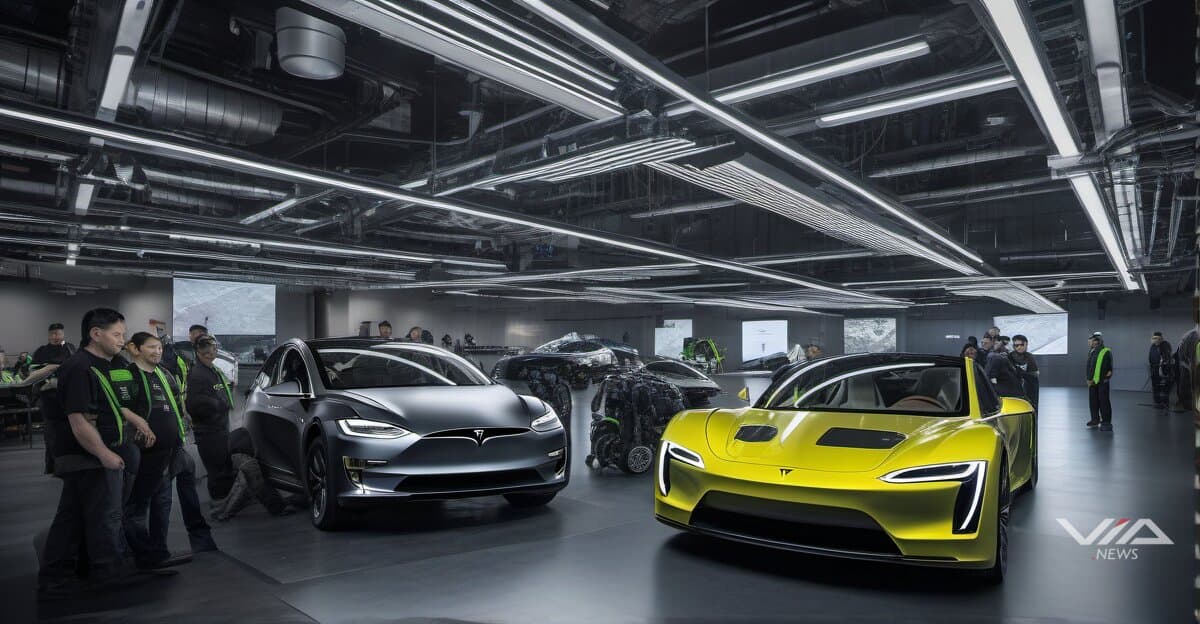
Image generated by AI for illustrative purposes. Not actual footage or photography from the reported events.

Nvidia, Microsoft, Tesla, and Intel all rallied during the same April 2026 window, coinciding with Taiwan Semiconductor's disclosure of increased AI-related demand. The synchronized timing across competing hardware providers points to broad institutional repositioning rather than company-specific catalysts.

Taiwan Semiconductor's AI chip order growth provides fundamental support for the rally. The foundry manufactures advanced processors for multiple AI infrastructure vendors, making its demand signals a leading indicator for the sector. Orders flowing to the world's largest contract chipmaker suggest AI deployments are reaching scale where hardware capacity becomes the constraint.

The rally cuts across different AI hardware segments. Nvidia dominates training accelerators, Microsoft controls cloud infrastructure, Intel competes in inference chips, and Tesla develops custom silicon for autonomous systems. Simultaneous gains across these distinct niches indicate investors are buying the entire AI hardware thesis rather than picking individual winners.

Market coordination at this level typically reflects institutional investment committee decisions rather than retail momentum. Large asset managers often rotate sector allocations in quarterly rebalancing, which would explain why competing firms moved together. The shift from AI software to hardware aligns with the technology adoption cycle—initial hype around applications gives way to infrastructure investment as use cases mature.

Taiwan Semiconductor sits at the center of AI hardware supply chains. Its production capacity limits how fast any chip designer can scale, regardless of architecture advantages. Strong order flow at the foundry level validates that AI infrastructure demand is real rather than speculative, supporting higher valuations across the sector.

The rally's strength and breadth suggest institutional investors are positioning for sustained AI hardware spending through mid-2026. If deployment continues scaling, companies that manufacture or design chips could see extended momentum as the market prices in multi-year infrastructure buildouts.

In this story · Knowledge Files

About this analysis

This is a Via News analysis. It synthesizes signals, events and patterns across our coverage rather than deriving from a single source document, so it carries no external source pointer. Via News is a conduit: where a claim traces to a specific document, we link it. How we source

LM Salvado
LM Salvado

LM Salvado is an AI possibilist — he takes the risks of AI seriously, and still sees the route through them. Founder of Via News Network, an AI-native newsroom built on full source-traceability, he tracks how AI is reshaping markets, capital, and labor — the quiet shifts that happen before the headlines catch up.

What we know · the intelligence behind this page
Live from the substrate
What we're seeing
AI's 'Show-Me' Reckoning: Earnings Divergence, Executive Exodus, and Regulatory Tightening
Investors are shifting from rewarding AI narratives to demanding tangible results, evidenced by Adobe's weak guidance despite user-growth emphasis, Palantir's stock decline even after winning the Army's TITAN contract, and UiPath's contrasting guidance raise. Simultaneously, high-profile safety-driven departures from Anthropic and Google, plus new regulatory actions (California's under-16 social media ban, Anthropic's misuse-blocking disclosures), signal mounting scrutiny of AI's societal and financial risk profile even as fintech-adjacent funding (Socure) continues.
Our read on the data ›
Signals we're tracking
Satellite-Terrestrial Network Integration Acceleration
Increased investment and launches in hybrid satellite-cellular networks across telecom industry; competitive responses from other carriers; regulatory activity around satellite spectrum; expansion of emergency/rural connectivity use cases
Patterns we're watching ›
Where sources disagree
ING Group
Both facts record the same metric (shares_outstanding) for ING Group at the identical observation date (2025-12-31). FACT A states 2,902,437,688 shares; FACT B states 2,902 million shares (2,902,000,000). The difference is 437,688 shares (~0.015%). This is a genuine value conflict, though the discrepancy appears to result from FACT B rounding to the nearest million while FACT A provides the precise count.
We flag conflicts openly ›
Recently verified
Checked against the original source
4,981
facts traced to their source — and we flag the ones that don't hold up.
101 entities tracked4,981 facts checked against source5,288 source documents archived
Query this data → isubstrate.com