Wednesday, September 16, 2026

TSMC's Taiwan Concentration Creates $400 Valuation Ceiling Despite AI Chip Dominance

TSMC faces a geopolitical risk discount that caps its fair value at $400 per share—7.3% below current levels—despite holding a central position in the AI chip supply chain. The company's concentrated Taiwan production creates a single-point-of-failure risk that outweighs record profits and dominant client relationships in AI infrastructure buildout.

LM Salvado
LM Salvado

April 12, 2026

TSMC's Taiwan Concentration Creates $400 Valuation Ceiling Despite AI Chip Dominance
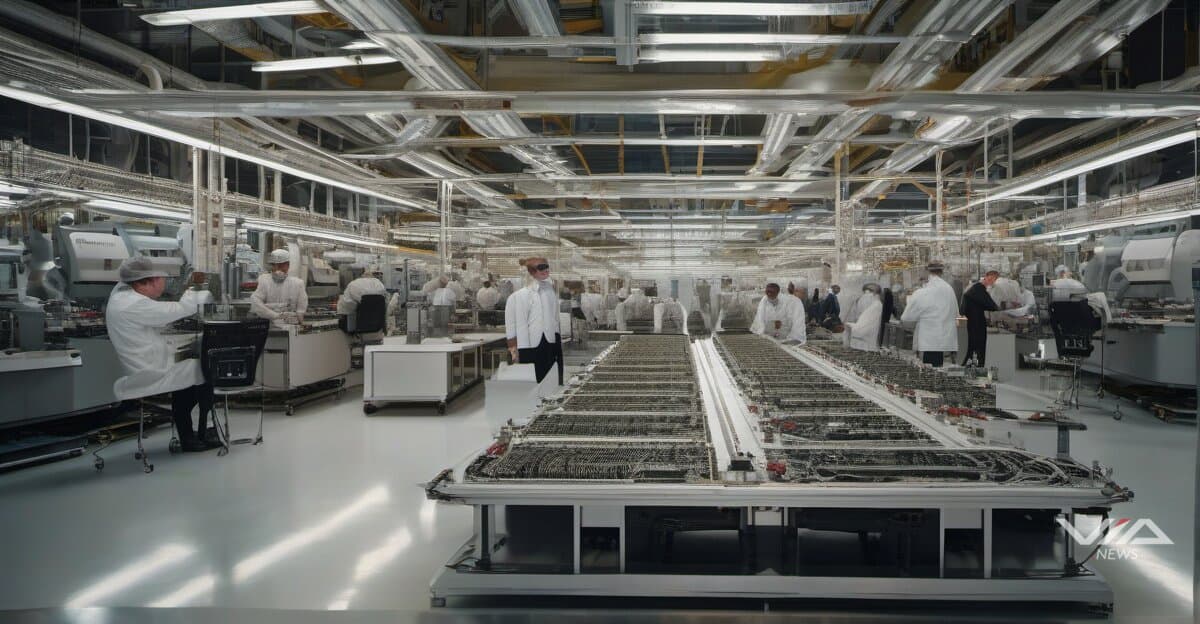
Image generated by AI for illustrative purposes. Not actual footage or photography from the reported events.

TSMC's fair value sits at $400 per share, representing a 7.3% undervaluation despite the company's central role powering the AI revolution.1 The discount reflects geopolitical risk from concentrated production in Taiwan, a vulnerability that creates supply chain shock exposure for global semiconductor customers.

The company supplies AI infrastructure buildout clients with record profits and maintains dominant relationships across the sector.1 Oscar Garcia identified TSMC as the central pillar of the global semiconductor ecosystem supporting AI development.1 Yet this market position cannot overcome the geographic concentration problem.

Taiwan-based production creates a single-point-of-failure scenario that threatens continuity for customers dependent on TSMC's advanced process nodes.1 Simply Wall St flagged this concentration as a material geopolitical shock risk to the supply chain.1 No amount of technical leadership or client loyalty eliminates the risk that cross-strait tensions could disrupt chip flows.

TSMC's heavy AI-focused capital expenditure plans add another layer of vulnerability.1 Large capex commitments lock the company into demand assumptions that may not materialize if AI infrastructure spending shifts or customers accelerate diversification efforts. Amazon's announced 2026 CapEx guidance increase will likely benefit TSMC, but this customer concentration intensifies rather than reduces supply chain fragility.1

The valuation ceiling reflects a structural problem: investors must price in the probability that geopolitical events force customers to seek alternative suppliers or that governments mandate supply chain diversification. TSMC's technological edge and economies of scale make replication difficult, but Taiwan Strait incidents will continue to trigger volatility and valuation compression relative to geographically diversified peers.

Corporate strategy teams at TSMC customers face a choice between cost-effective production and supply chain resilience. The current fair value assessment suggests the market expects this tension to constrain TSMC's premium despite strong fundamentals. Until production diversifies geographically, the company trades at a discount to its operational performance.

In this story · Knowledge Files

About this analysis

This is a Via News analysis. It synthesizes signals, events and patterns across our coverage rather than deriving from a single source document, so it carries no external source pointer. Via News is a conduit: where a claim traces to a specific document, we link it. How we source

LM Salvado
LM Salvado

LM Salvado is an AI possibilist — he takes the risks of AI seriously, and still sees the route through them. Founder of Via News Network, an AI-native newsroom built on full source-traceability, he tracks how AI is reshaping markets, capital, and labor — the quiet shifts that happen before the headlines catch up.

What we know · the intelligence behind this page
Live from the substrate
What we're seeing
AI's 'Show-Me' Reckoning: Earnings Divergence, Executive Exodus, and Regulatory Tightening
Investors are shifting from rewarding AI narratives to demanding tangible results, evidenced by Adobe's weak guidance despite user-growth emphasis, Palantir's stock decline even after winning the Army's TITAN contract, and UiPath's contrasting guidance raise. Simultaneously, high-profile safety-driven departures from Anthropic and Google, plus new regulatory actions (California's under-16 social media ban, Anthropic's misuse-blocking disclosures), signal mounting scrutiny of AI's societal and financial risk profile even as fintech-adjacent funding (Socure) continues.
Our read on the data ›
Signals we're tracking
Satellite-Terrestrial Network Integration Acceleration
Increased investment and launches in hybrid satellite-cellular networks across telecom industry; competitive responses from other carriers; regulatory activity around satellite spectrum; expansion of emergency/rural connectivity use cases
Patterns we're watching ›
Where sources disagree
ING Group
Both facts record the same metric (shares_outstanding) for ING Group at the identical observation date (2025-12-31). FACT A states 2,902,437,688 shares; FACT B states 2,902 million shares (2,902,000,000). The difference is 437,688 shares (~0.015%). This is a genuine value conflict, though the discrepancy appears to result from FACT B rounding to the nearest million while FACT A provides the precise count.
We flag conflicts openly ›
Recently verified
Checked against the original source
4,981
facts traced to their source — and we flag the ones that don't hold up.
101 entities tracked4,981 facts checked against source5,288 source documents archived
Query this data → isubstrate.com