Thursday, September 24, 2026

Micron, Dell, Intel Surge While AI Software Stocks Fall, Confirming Sector Rotation

Semiconductor and HPC infrastructure stocks gained 3-5% on June 25 as enterprise AI software names declined and the Nasdaq Composite fell. The divergence confirms capital rotating out of the application layer into picks-and-shovels hardware. Hardware-adjacent investments — semiconductor ETFs and AI data center REITs — are positioned to outperform over 3-6 months.

LM Salvado
LM Salvado

June 25, 2026

Micron, Dell, Intel Surge While AI Software Stocks Fall, Confirming Sector Rotation
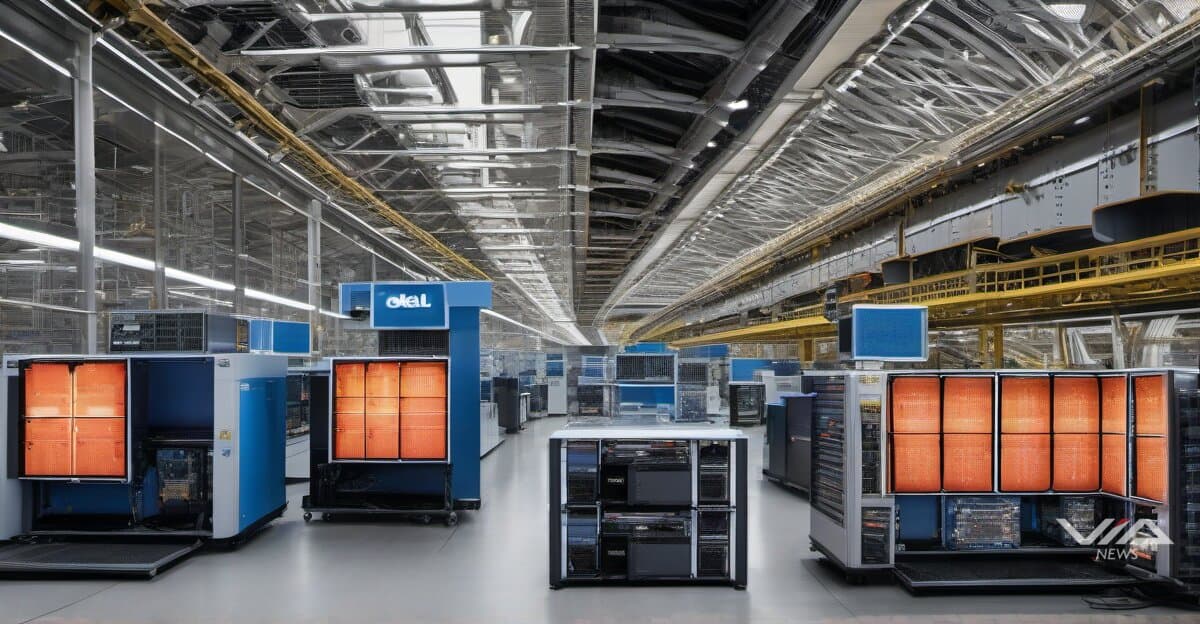
Image generated by AI for illustrative purposes. Not actual footage or photography from the reported events.
4%.1 All are infrastructure-facing names. The Nasdaq's simultaneous decline rules out a broad risk-on move — this is sector rotation.

Capital is leaving the AI application layer. Enterprise AI services and software vendors sold off as hardware names rallied. The divergence is structural, not noise.1

The logic is direct. Data center buildout is accelerating regardless of enterprise software adoption cycles. Hyperscalers and governments are committing capital to GPU clusters, memory, and storage now. Hardware spending does not wait for corporate IT budget cycles to clear.

Enterprise AI software faces the opposite dynamic. Deployment cycles are long. Budget approvals are slow. Competition among AI service vendors is compressing margins before scale arrives. Fintech AI companies tied to corporate spending cycles carry elevated near-term risk.1

Two investment tracks are diverging:

  • Infrastructure beneficiaries: Semiconductor manufacturers, HPC integrators, memory storage providers, AI data center REITs
  • Application layer pressure: Enterprise SaaS, fintech AI vendors, cloud-based AI service providers

Semiconductor ETFs tracking names like Micron, Intel, and KLA have held up as software-heavy indexes declined. AI data center REITs — which own and operate physical facilities running GPU workloads — are positioned to benefit from multi-year infrastructure spending commitments.1

The 3-6 month outlook favors the picks-and-shovels trade.1 Infrastructure demand is anchored to hyperscaler capex, which remains elevated. Enterprise AI software demand depends on corporate adoption — slower and more discretionary.

June 25's price action is the confirmation. The Nasdaq falling while semis rally is allocation, not volatility.

In this story · Knowledge Files

About this analysis

This is a Via News analysis. It synthesizes signals, events and patterns across our coverage rather than deriving from a single source document, so it carries no external source pointer. Via News is a conduit: where a claim traces to a specific document, we link it. How we source

LM Salvado
LM Salvado

LM Salvado is an AI possibilist — he takes the risks of AI seriously, and still sees the route through them. Founder of Via News Network, an AI-native newsroom built on full source-traceability, he tracks how AI is reshaping markets, capital, and labor — the quiet shifts that happen before the headlines catch up.

What we know · the intelligence behind this page
Live from the substrate
What we're seeing
Enterprise AI Agents Go Mainstream, But Trustworthy Data Access Lags Adoption
A wave of enterprise AI agent activity — fresh funding (Latitude's $35M Series A), a run of CB Insights CEO interviews spotlighting fintech- and healthcare-focused agent startups (Covecta, Penguin AI, Maisa AI), and major platform partnerships (Microsoft-Mistral, Manulife-Microsoft AI governance, Siemens-NVIDIA agentic EDA, Box's agent security controls) — signals agentic AI moving from pilot to production across financial and enterprise workflows. Yet Google Cloud's own research shows adoption is outrunning data readiness (companies average AI access to only 45% of their data, with 'data laggards' capped near 30%), while insider selling at incumbent C3.ai hints at mixed investor conviction even as the broader ecosystem accelerates.
Our read on the data ›
Signals we're tracking
Satellite-Terrestrial Network Integration Acceleration
Increased investment and launches in hybrid satellite-cellular networks across telecom industry; competitive responses from other carriers; regulatory activity around satellite spectrum; expansion of emergency/rural connectivity use cases
Patterns we're watching ›
Where sources disagree
ING Group
Both facts record the same metric (shares_outstanding) for ING Group at the identical observation date (2025-12-31). FACT A states 2,902,437,688 shares; FACT B states 2,902 million shares (2,902,000,000). The difference is 437,688 shares (~0.015%). This is a genuine value conflict, though the discrepancy appears to result from FACT B rounding to the nearest million while FACT A provides the precise count.
We flag conflicts openly ›
Recently verified
Checked against the original source
4,983
facts traced to their source — and we flag the ones that don't hold up.
101 entities tracked4,983 facts checked against source5,305 source documents archived
Query this data → isubstrate.com