Friday, August 21, 2026
What we know · the intelligence behind this page
Live from the substrate
What we're seeing
AI Platforms Rush to Establish Content-Authenticity Standards Amid Leadership Shakeups and Sustained Capex
Within days of each other in mid-August 2026, Google, Anthropic, and Spotify moved to formalize AI content watermarking and labeling policies, signaling an industry-wide push toward self-governed provenance standards as generative AI output floods consumer platforms. The shift coincides with executive turnover at OpenAI (Brad Lightcap's departure) and Meta's public AI manifesto, all set against continued heavy AI infrastructure capital expenditure and finance-sector moves (e.g., Wall Street paying for algorithmic edges on social signals) that underscore AI's deepening entanglement with capital markets.
Our read on the data ›
Signals we're tracking
EPKINLY Regulatory-Clinical Success Cascade
High probability of expanded label indications, additional combination approvals, and competitive positioning strength in follicular lymphoma market. Predicts positive commercial uptake and potential accelerated review for related indications.
Patterns we're watching ›
Where sources disagree
JPMorgan Chase & Co.
Both facts report JPMorgan Chase & Co.'s revenue for the same fiscal period (FY 2025) with the same observation date (2025-12-31), but with different values: $182.447 billion vs. $185 billion. The ~1.4% difference ($2.553 billion) is too large to be explained by rounding alone and represents conflicting data for the identical time period.
We flag conflicts openly ›
Recently verified
Checked against the original source
4,977
facts traced to their source — and we flag the ones that don't hold up.
101 entities tracked4,977 facts checked against source5,242 source documents archived
Work with this data → vianewsagency.com

Nigeria's NSIA Deploys Sovereign Capital Into AI Infrastructure as Kasi LOS1 Goes Live

Nigeria's sovereign wealth fund, NSIA, has committed capital to AI infrastructure in a funding event timed with the commissioning of the Kasi LOS1 facility. Policy, regulation, subsea connectivity, and state capital are converging simultaneously. The move positions West Africa for a wave of local AI compute access within 6 to 18 months.

L.M. Salvado
L.M. Salvado

May 21, 2026

Nigeria's NSIA Deploys Sovereign Capital Into AI Infrastructure as Kasi LOS1 Goes Live
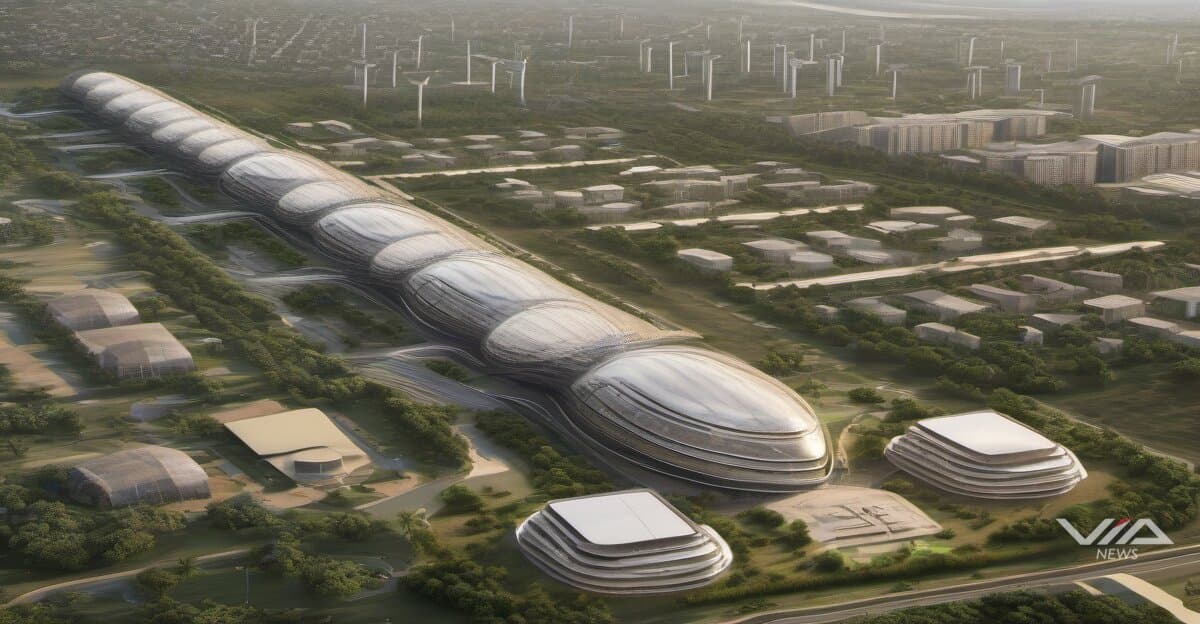
Image generated by AI for illustrative purposes. Not actual footage or photography from the reported events.

Nigeria's NSIA sovereign wealth fund has backed a domestic AI infrastructure build-out in a funding event that coincides with the commissioning of Kasi LOS1, a hyperscale data center facility.1 The pairing of sovereign capital with operational compute capacity marks a structural shift in how West Africa's AI economy is being built.

Four enabling factors have converged at once.1 Nigeria's National Cloud Policy 2025 establishes the regulatory mandate. The Nigeria Data Protection Act 2023 provides data governance rules. The 2Africa and Equiano subsea cable systems supply high-capacity international connectivity. NSIA funding now adds the capital layer.

Nigerian fintech and AI firms currently send most AI workloads to European or US cloud providers.1 That dependency carries latency costs and data sovereignty exposure. Local hyperscale compute access is projected to become available within 6 to 18 months, removing both constraints.

Nigeria's domestic market is approximately 200 million people.1 Fintech penetration is high relative to banking infrastructure. Local AI compute unlocks product development that has been architecturally constrained by offshore processing—credit scoring models, fraud detection, and real-time lending decisions all benefit from low-latency regional infrastructure.

A wave of Nigerian fintech AI product launches and B2B AI services targeting the domestic market is anticipated once Kasi LOS1 reaches operational capacity.1 The regulatory and connectivity groundwork reduces typical go-to-market friction for AI-native financial products.

The NSIA move is likely to accelerate peer activity.1 Sovereign funds in Kenya, South Africa, and Egypt are projected to announce comparable AI infrastructure commitments within 12 months. State-backed infrastructure investment signals policy durability that private capital alone cannot provide—a meaningful distinction for institutional investors assessing African digital economy exposure.

Sovereign-led AI infrastructure differs from venture-backed build-outs in risk profile and timeline. Returns are longer-dated but underpinned by government mandate rather than market adoption alone. For investors in African fintech and infrastructure, the NSIA event represents a credible inflection point rather than speculative positioning.

About this analysis

This is a Via News analysis. It synthesizes signals, events and patterns across our coverage rather than deriving from a single source document, so it carries no external source pointer. Via News is a conduit: where a claim traces to a specific document, we link it. How we source

L.M. Salvado
L.M. Salvado

L.M. Salvado is an AI possibilist — he takes the risks of AI seriously, and still sees the route through them. Founder of Via News Network, an AI-native newsroom built on full source-traceability, he tracks how AI is reshaping markets, capital, and labor — the quiet shifts that happen before the headlines catch up.