
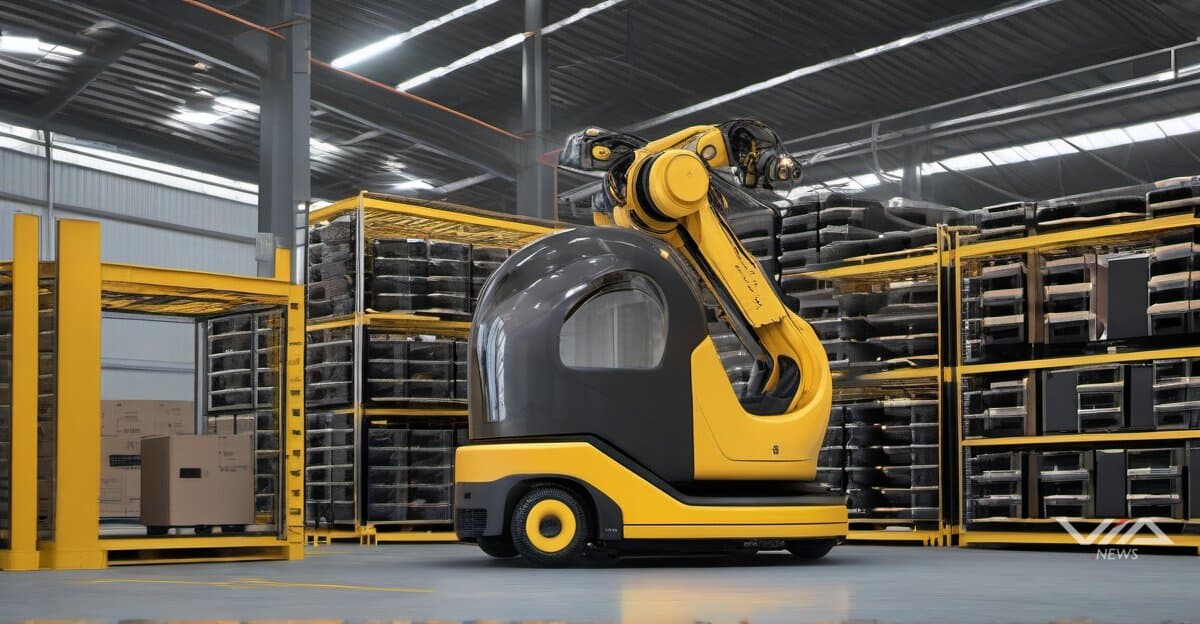
Warehouse automation firm Nomagic's Shoebox Picker handles more than 98% of shoeboxes on the market, marking a milestone for specialized robotic systems in logistics. The technology demonstrates how narrowly-focused automation outperforms general-purpose robots in commercial settings.
Autonomous vehicle maker Nuro is advancing toward commercial robotaxi deployment by end-2026, backed by on-road testing that validates years of autonomous delivery operations. The company's safety framework, developed through commercial deployments, positions it for regulated passenger transport markets.
Physical AI integration is accelerating across warehouse and logistics operations. "Our vision is to bring physical AI into the heart of warehouse and logistics operations, where intelligent, autonomous systems can finally bridge the gap between digital optimization and real-world execution," said Kacper Nowicki of a recent funding recipient. Several robotics startups closed rounds exceeding $100M in recent months.
Talent movement between OpenAI, Meta, and robotics firms like Covariant indicates strategic repositioning. Engineers with foundation model experience are joining companies building application-specific systems, suggesting the industry values deployment expertise over pure research capabilities.
Chinese robotics manufacturers are expanding into Middle Eastern markets. "In Saudi Arabia's digital transformation, Chinese robots are already supporting high-tech sectors such as logistics, smart manufacturing, healthcare, and smart city services," said Mohammed Alsolami. The technology enables Saudi entities to scale automation in months rather than years, aligning with Vision 2030 timelines.
Naval and manufacturing sectors are forming partnerships for physical AI deployment, though specific contract values remain undisclosed. These collaborations focus on autonomous systems for inspection, maintenance, and material handling in challenging environments.
The sector's maturation reflects investor preference for proven commercial applications over experimental platforms. Companies demonstrating measurable performance improvements in specific tasks are securing larger funding rounds than those pursuing general-purpose robotics. This pattern mirrors broader AI investment trends favoring vertical-specific solutions.
Market analysts expect warehouse automation spending to increase as labor costs rise and e-commerce fulfillment demands intensify. Specialized picking robots, autonomous material transport, and inventory management systems represent the highest near-term ROI categories for logistics operators.