Saturday, September 5, 2026

NYSE Rebuilds Market Infrastructure on NVIDIA Silicon and Redpanda Streaming

NYSE is partnering with NVIDIA, HPE, and Redpanda to overhaul its market infrastructure using AI-optimized chips and high-throughput data pipelines. The shift is expected to accelerate industry-wide capital expenditure on AI-native infrastructure in H2 2026. Legacy vendors including Broadridge, SS&C, and FIS face competitive pressure as exchanges modernize in-house.

LM Salvado
LM Salvado

June 7, 2026

NYSE Rebuilds Market Infrastructure on NVIDIA Silicon and Redpanda Streaming
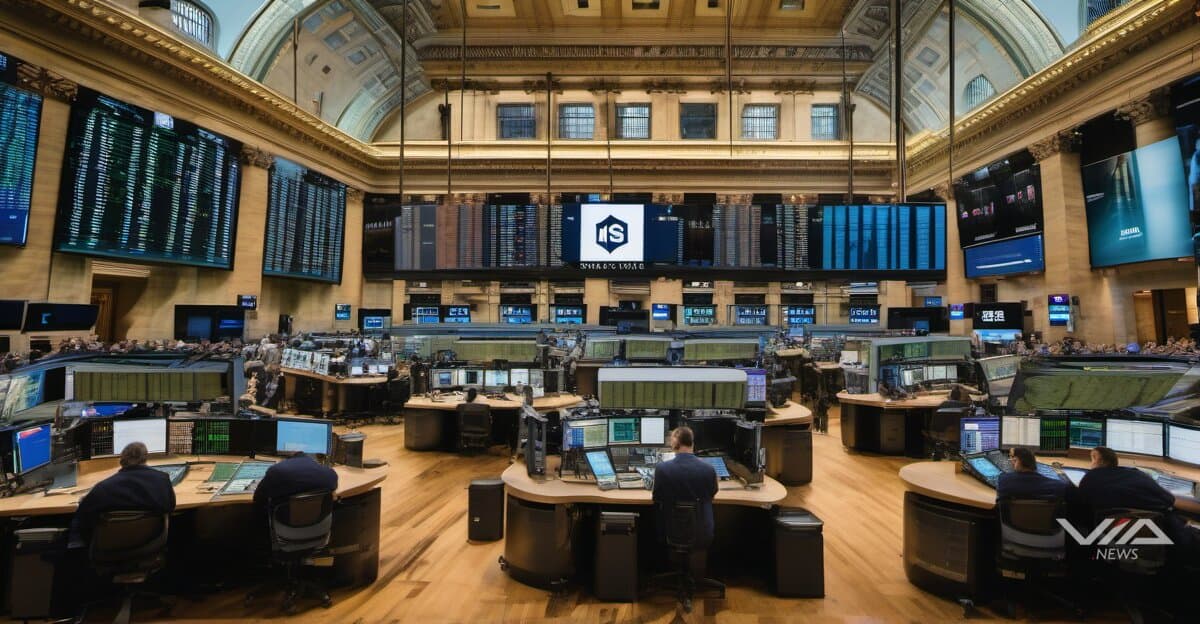
Image generated by AI for illustrative purposes. Not actual footage or photography from the reported events.

NYSE is partnering with NVIDIA, HPE, and Redpanda to rebuild its market infrastructure on AI-optimized silicon and high-throughput streaming.1

NVIDIA's Vera CPU and BlueField-4 STX data processing unit form the hardware core of the new stack.1 The BlueField-4 STX offloads networking and security tasks from the main CPU. That frees compute resources for inference workloads running alongside real-time trading operations.

HPE provides the server infrastructure layer. Redpanda handles data pipelines — a Kafka-compatible streaming platform built for financial data workloads.1 Kafka compatibility preserves existing application integrations. Exchanges can migrate without rewriting upstream systems.

The stack is a direct challenge to legacy market data vendors. Broadridge, SS&C, and FIS built their platforms on older infrastructure.1 As exchanges move workloads in-house onto purpose-built silicon, third-party middleware loses relevance. Margin pressure follows.

Financial exchanges are projected to accelerate capital expenditure on AI-native infrastructure in H2 2026.1 NVIDIA's data center segment benefits directly. Each exchange modernization cycle generates server, DPU, and networking spend.

The performance gap between old and new stacks is structural. Legacy market data systems were designed for throughput — moving bytes fast. AI-native stacks run inference at wire speed — deriving signals from data as it arrives. That gap widens as trading strategies incorporate more real-time AI.

NYSE's stack choice functions as a reference architecture. When the world's largest equity exchange standardizes on a vendor combination, smaller exchanges, clearinghouses, and market operators pay attention. Technology adoption in financial infrastructure tends to follow the largest operators.

For institutional investors, the build-out creates a durable capital allocation theme. NVIDIA data center revenue gains a financial services vertical alongside cloud hyperscalers. HPE captures server refresh cycles. Redpanda competes for streaming contracts previously held by legacy messaging vendors.

The displacement risk for Broadridge, SS&C, and FIS is contract-level for now. But exchanges building AI-native stacks in-house reduce long-term dependency on managed services. That structural shift compounds over time.

In this story · Knowledge Files

About this analysis

This is a Via News analysis. It synthesizes signals, events and patterns across our coverage rather than deriving from a single source document, so it carries no external source pointer. Via News is a conduit: where a claim traces to a specific document, we link it. How we source

LM Salvado
LM Salvado

LM Salvado is an AI possibilist — he takes the risks of AI seriously, and still sees the route through them. Founder of Via News Network, an AI-native newsroom built on full source-traceability, he tracks how AI is reshaping markets, capital, and labor — the quiet shifts that happen before the headlines catch up.

What we know · the intelligence behind this page
Live from the substrate
What we're seeing
AI Capital Surge Meets Investor Caution: Record Funding Rounds and Government Contracts Amid Valuation Skepticism
A single-week cluster of large AI/fintech funding rounds (Socure, Stability AI, Emerald AI, Generalist AI, Instinct, Gatik, Regent Craft) shows venture capital still pouring into AI infrastructure, identity, and autonomy plays, while Palantir's Army TITAN contract win coincided with a 6% stock drop — signaling that even flagship AI-defense revenue isn't immune to market reassessment of AI valuations. Efficiency-focused innovations like Multiverse Computing's model compression suggest the sector is also pivoting toward cost/inference economics as capital intensity draws scrutiny.
Our read on the data ›
Signals we're tracking
EPKINLY Regulatory-Clinical Success Cascade
High probability of expanded label indications, additional combination approvals, and competitive positioning strength in follicular lymphoma market. Predicts positive commercial uptake and potential accelerated review for related indications.
Patterns we're watching ›
Where sources disagree
Morgan Stanley & Co. LLC
The same metric (eps) for the same entity (Morgan Stanley & Co. LLC) reported for the identical fiscal period (Q1 2026) and observation date (2026-03-31) has two conflicting values: 3.43 USD_per_share vs 3.08 USD. This is not a temporal change — both observations claim to measure the same point in time. The ~10% discrepancy (0.35 USD difference) is material for a financial metric.
We flag conflicts openly ›
Recently verified
Checked against the original source
4,981
facts traced to their source — and we flag the ones that don't hold up.
101 entities tracked4,981 facts checked against source5,273 source documents archived
Query this data → isubstrate.com