Saturday, October 10, 2026

Blackcomb Pipeline's 2.5 Bcf/d Capacity Targets $30B Gulf Coast LNG Buildout

MPLX's Blackcomb Pipeline will add 2.5 billion cubic feet per day of Permian gas transport capacity to Gulf Coast LNG terminals by late 2028. The project addresses infrastructure gaps as U.S. LNG export capacity expands from 12 Bcf/d today to 24 Bcf/d by 2030. Permian gas production growth of 3-4 Bcf/d through 2028 requires matching pipeline investment to reach coastal demand centers.

Source Trace Score1 source document1 with a live linkVerifiability: Basic
Blackcomb Pipeline's 2.5 Bcf/d Capacity Targets $30B Gulf Coast LNG Buildout
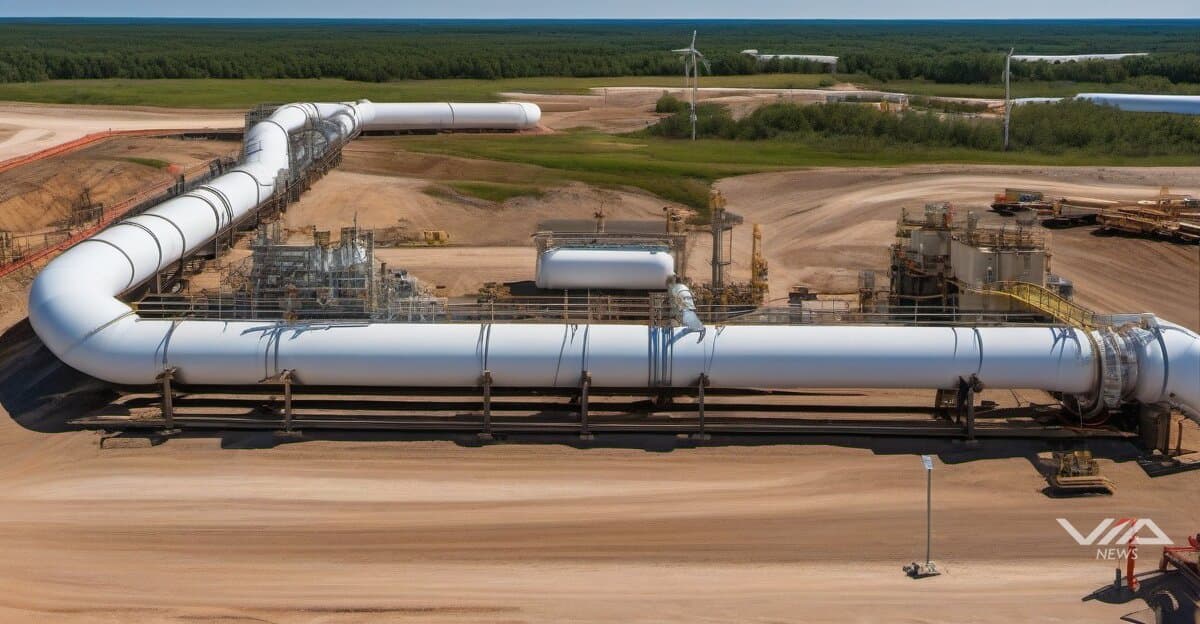
Image generated by AI for illustrative purposes. Not actual footage or photography from the reported events.

MPLX is commissioning the Blackcomb Pipeline in late 2028, adding 2.5 billion cubic feet per day of natural gas transport from the Permian Basin to Gulf Coast LNG export facilities. The midstream project connects rising shale gas output with terminals handling liquefaction for Asian and European buyers.

U.S. LNG export capacity stands at 12 Bcf/d currently. Industry data shows 12 Bcf/d of additional capacity under construction, targeting 2028-2030 completion dates. Gulf Coast terminals account for 85% of planned expansions, requiring pipeline systems to move gas 500+ miles from production fields.

Permian Basin gas output reached 22 Bcf/d in 2024. Energy Information Administration forecasts show production climbing to 25-26 Bcf/d by 2028, driven by oil drilling that produces associated gas. Blackcomb captures a 10% share of the incremental volume needing Gulf Coast access.

Pipeline economics favor long-term contracts with investment-grade shippers. MPLX structured Blackcomb with 15-20 year take-or-pay agreements, guaranteeing revenue regardless of throughput. This model attracted $2-3 billion in project financing at 5.5-6.5% interest rates during 2023-2024 construction phases.

Competing pipelines from Kinder Morgan, Energy Transfer, and TC Energy add 8-10 Bcf/d of Permian-to-Gulf capacity by 2029. Total investment in Permian gas infrastructure exceeds $15 billion across five major systems. Utilization rates on existing lines run at 90-95%, supporting additional capacity buildouts.

LNG projects require gas supply certainty before reaching final investment decisions. Venture Global LNG, Sempra Infrastructure, and Cheniere Energy each announced 2-3 mtpa expansions in 2024-2025, contingent on firm pipeline capacity. Blackcomb's 2028 commissioning aligns with Plaquemines LNG Phase 2 and Port Arthur LNG expansions entering service.

Natural gas futures for 2028 delivery at Henry Hub trade at $3.80-4.20/MMBtu. Asian LNG spot prices average $11-13/MMBtu, creating $7-9 arbitrage margins that justify infrastructure spending. Pipeline tariffs of $0.40-0.60/MMBtu represent 5-8% of total delivered costs to LNG facilities.

Midstream MLPs financing these systems offer 7-9% distribution yields, attracting income-focused investors. MPLX trades at 9.2x EBITDA with 8.1% yield, typical for the sector.

Source documents

Via News is a conduit. We point to the source documents behind this report — we don't replace them. Trace any claim to its source and decide what to trust. How we source

Source Trace Score1 source document1 with a live linkVerifiability: Basic
  1. [1]News articleYahoo Finance· February 20, 2026
    MPLX LP: Why This Midstream MLP Deserves a Premium Valuation
What we know · the intelligence behind this page
Live from the substrate
What we're seeing
Agentic Enterprise Software Consolidates: Big Platforms Push Autonomy While Startups Get Absorbed
Enterprise software is shifting toward autonomous, AI-agent-driven products. SAP (Autonomous Enterprise, Joule), Meta (a new Enterprise Platform led by ex-MongoDB CEO Chirantan Desai) and UiPath (raised guidance) are pushing from the top. Meanwhile AI-security and governance startups are being acquired (Fortinet–Virtue AI, Harvey–Guardrails AI, Tiny–Oso Cloud) and seed-stage agent companies keep raising capital (Dextr, Latitude, Groq). Investors such as Norwest's Sean Jacobsohn see finance and ERP back-office software as the easier area to disrupt. Trust and enforced governance are treated as preconditions for regulated sectors like finance, and AI is judged unreliable for calculations.
Our read on the data ›
Signals we're tracking
EPKINLY Regulatory-Clinical Success Cascade
High probability of expanded label indications, additional combination approvals, and competitive positioning strength in follicular lymphoma market. Predicts positive commercial uptake and potential accelerated review for related indications.
Patterns we're watching ›
Where sources disagree
ING Group
Both facts record the same metric (shares_outstanding) for ING Group at the identical observation date (2025-12-31). FACT A states 2,902,437,688 shares; FACT B states 2,902 million shares (2,902,000,000). The difference is 437,688 shares (~0.015%). This is a genuine value conflict, though the discrepancy appears to result from FACT B rounding to the nearest million while FACT A provides the precise count.
We flag conflicts openly ›
Recently verified
✓ Checked against the original source
4,986
facts traced to their source — and we flag the ones that don't hold up.
101 entities tracked4,986 facts checked against source5,365 source documents archived
Query this data → isubstrate.com