Wednesday, September 16, 2026

NVIDIA Locks In Pharma Giants Lilly and Thermo Fisher as Biotech AI Race Accelerates

NVIDIA's BioNeMo platform secured partnerships with Eli Lilly and Thermo Fisher Scientific, positioning the chipmaker as infrastructure provider for AI-driven drug discovery. Five biotech AI firms launched competing foundation model platforms simultaneously, signaling industry-wide adoption of AI-native workflows built on NVIDIA's technology stack.

LM Salvado
LM Salvado

April 11, 2026

Source Trace Score1 source document1 with a live linkVerifiability: Basic
NVIDIA Locks In Pharma Giants Lilly and Thermo Fisher as Biotech AI Race Accelerates
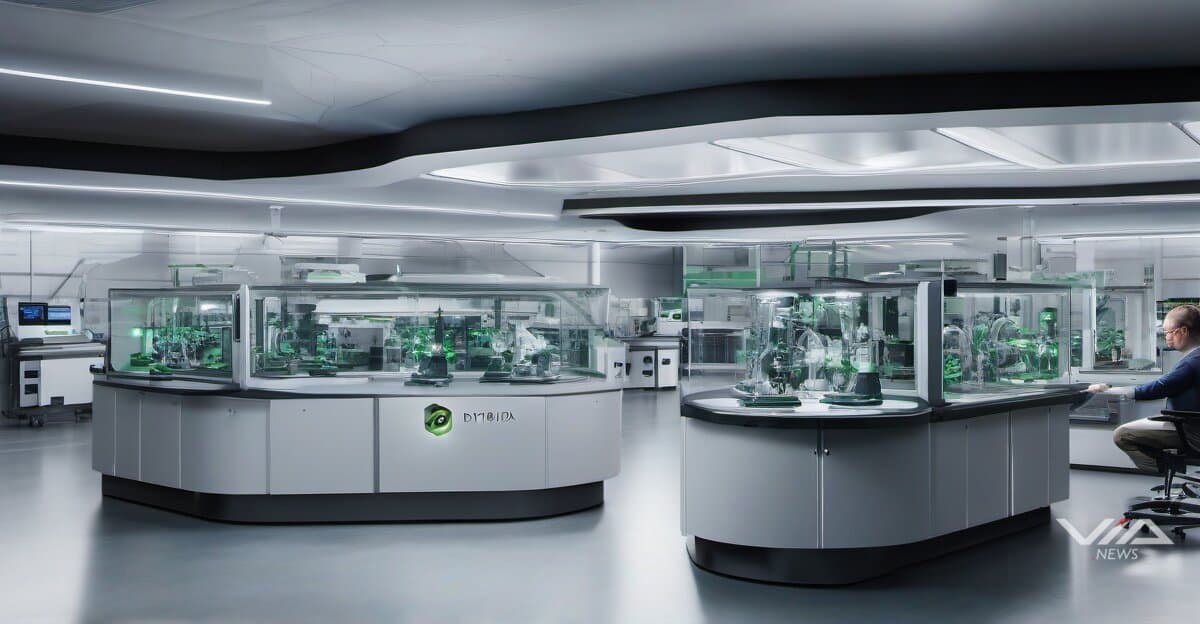
Image generated by AI for illustrative purposes. Not actual footage or photography from the reported events.

NVIDIA's BioNeMo platform has been adopted by major pharmaceutical companies Eli Lilly and Thermo Fisher Scientific to accelerate AI-driven drug discovery.1 The partnerships establish NVIDIA as the foundational infrastructure provider for computational biology as the industry shifts toward AI-native research workflows.

Five biotech AI companies—Natera, Basecamp Research, Owkin, Edison Scientific, and Boltz Lab—launched foundation model platforms in recent months, all relying on NVIDIA's technology stack.1 The simultaneous rollouts indicate coordinated infrastructure buildout across the sector rather than isolated experiments.

BioNeMo provides pre-trained AI models for protein structure prediction, molecular generation, and genomic analysis. Pharmaceutical companies can customize these models for proprietary drug discovery programs without building AI infrastructure from scratch. Thermo Fisher will integrate BioNeMo into laboratory automation systems, while Lilly plans to deploy the platform across early-stage drug development.

The strategic value lies in speed and cost reduction. Traditional drug discovery takes 10-15 years and costs over $2 billion per approved medication. AI models can screen millions of molecular compounds in weeks, identifying candidates for laboratory testing far earlier in the development cycle.

For investors, NVIDIA's positioning mirrors its data center strategy: provide the infrastructure layer that captures value regardless of which biotech applications succeed. As pharmaceutical companies compete on AI capabilities, demand for NVIDIA's GPUs and specialized biotech software creates recurring revenue independent of individual drug outcomes.

The biotech AI buildout differs from consumer AI adoption patterns. Pharmaceutical companies face regulatory requirements for model transparency and validation that favor established infrastructure providers over startups. NVIDIA's partnerships with industry leaders like Lilly signal that major drugmakers will standardize on proven platforms rather than risk compliance issues with unvetted alternatives.

The timing aligns with patent cliffs facing major pharmaceutical companies in 2026-2028. Blockbuster drugs losing exclusivity will pressure R&D productivity, making AI acceleration strategically necessary rather than experimental. NVIDIA's early partnerships position the company to capture infrastructure spending as the industry shifts research budgets toward computational methods.

Source documents

Via News is a conduit. We point to the source documents behind this report — we don't replace them. Trace any claim to its source and decide what to trust. How we source

Source Trace Score1 source document1 with a live linkVerifiability: Basic
  1. [1]News articleYahoo Finance· January 12, 2026
    NVIDIA BioNeMo Platform Adopted by Life Sciences Leaders to Accelerate AI-Driven Drug Discovery

In this story · Knowledge Files

LM Salvado
LM Salvado

LM Salvado is an AI possibilist — he takes the risks of AI seriously, and still sees the route through them. Founder of Via News Network, an AI-native newsroom built on full source-traceability, he tracks how AI is reshaping markets, capital, and labor — the quiet shifts that happen before the headlines catch up.

What we know · the intelligence behind this page
Live from the substrate
What we're seeing
AI's 'Show-Me' Reckoning: Earnings Divergence, Executive Exodus, and Regulatory Tightening
Investors are shifting from rewarding AI narratives to demanding tangible results, evidenced by Adobe's weak guidance despite user-growth emphasis, Palantir's stock decline even after winning the Army's TITAN contract, and UiPath's contrasting guidance raise. Simultaneously, high-profile safety-driven departures from Anthropic and Google, plus new regulatory actions (California's under-16 social media ban, Anthropic's misuse-blocking disclosures), signal mounting scrutiny of AI's societal and financial risk profile even as fintech-adjacent funding (Socure) continues.
Our read on the data ›
Signals we're tracking
Satellite-Terrestrial Network Integration Acceleration
Increased investment and launches in hybrid satellite-cellular networks across telecom industry; competitive responses from other carriers; regulatory activity around satellite spectrum; expansion of emergency/rural connectivity use cases
Patterns we're watching ›
Where sources disagree
ING Group
Both facts record the same metric (shares_outstanding) for ING Group at the identical observation date (2025-12-31). FACT A states 2,902,437,688 shares; FACT B states 2,902 million shares (2,902,000,000). The difference is 437,688 shares (~0.015%). This is a genuine value conflict, though the discrepancy appears to result from FACT B rounding to the nearest million while FACT A provides the precise count.
We flag conflicts openly ›
Recently verified
Checked against the original source
4,981
facts traced to their source — and we flag the ones that don't hold up.
101 entities tracked4,981 facts checked against source5,288 source documents archived
Query this data → isubstrate.com