Tuesday, August 18, 2026
What we know · the intelligence behind this page
Live from the substrate
What we're seeing
Enterprise AI Agent Rollout Outpaces Data Trust and Readiness
Enterprise adoption of agentic AI is accelerating fast — Siemens deepening its NVIDIA partnership for self-verifying agentic AI in chip design, Manulife expanding its Microsoft AI-governance partnership, and a wave of infrastructure launches (NVIDIA GPU-accelerated data processing, Dell exascale storage, new AI chip generations) — even as a new Google Cloud survey shows the underlying data foundation isn't ready: companies have AI access to only 45% of their data on average, data laggards see access fall to 30% or less, and only about half of organizations trust their AI agents' decisions. Meanwhile, insider selling at enterprise-AI bellwether C3.ai (CEO Thomas Siebel offloading $4.8M in shares) hints at investor caution layered under the adoption hype.
Our read on the data ›
Signals we're tracking
Satellite-Terrestrial Network Integration Acceleration
Increased investment and launches in hybrid satellite-cellular networks across telecom industry; competitive responses from other carriers; regulatory activity around satellite spectrum; expansion of emergency/rural connectivity use cases
Patterns we're watching ›
Where sources disagree
JPMorgan Chase & Co.
Both facts report JPMorgan Chase & Co.'s revenue for the same fiscal period (FY 2025) with the same observation date (2025-12-31), but with different values: $182.447 billion vs. $185 billion. The ~1.4% difference ($2.553 billion) is too large to be explained by rounding alone and represents conflicting data for the identical time period.
We flag conflicts openly ›
Recently verified
Checked against the original source
4,812
facts traced to their source — and we flag the ones that don't hold up.
101 entities tracked4,812 facts checked against source5,219 source documents archived
Work with this data → vianewsagency.com

NVIDIA Launches Vertical AI Platforms for Space, Warehouses, and Chip Design

NVIDIA unveiled three industry-specific AI platforms on March 16, targeting space computing, warehouse automation, and semiconductor design. The Space Computing Platform and Space-1 Vera Rubin Module mark the company's entry into orbital computing infrastructure. Partnerships with KION, Siemens, and Accenture extend AI capabilities into logistics operations.

L.M. Salvado
L.M. Salvado

March 18, 2026

NVIDIA Launches Vertical AI Platforms for Space, Warehouses, and Chip Design
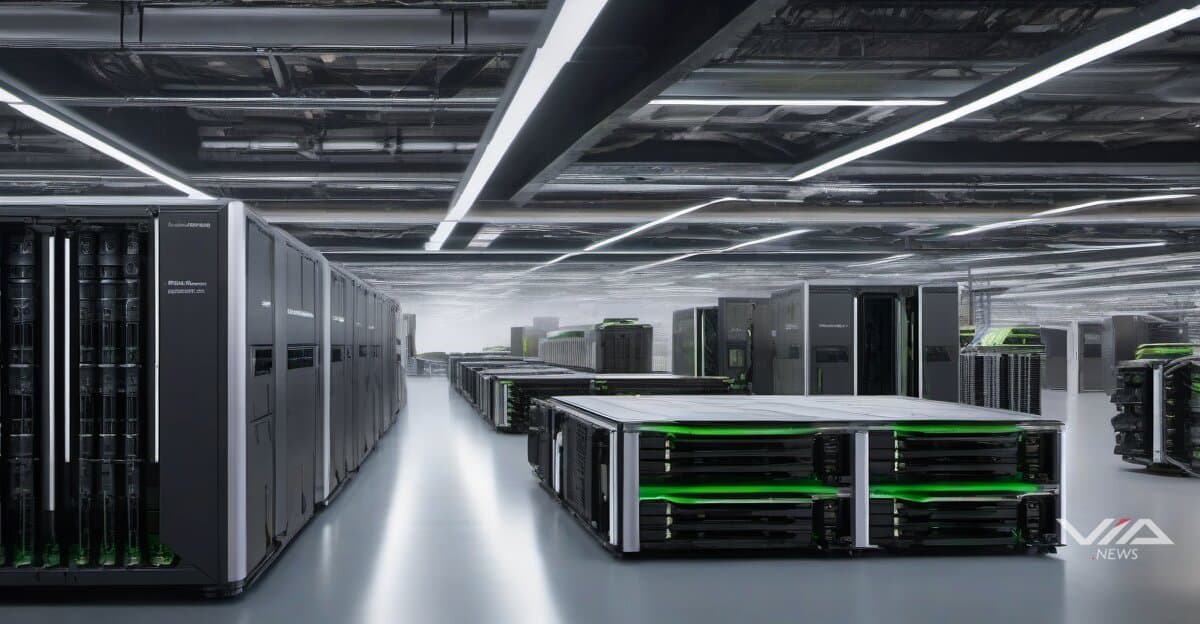
Image generated by AI for illustrative purposes. Not actual footage or photography from the reported events.

NVIDIA announced its Space Computing Platform and Space-1 Vera Rubin Module on March 16, 2026, entering the orbital computing market with domain-optimized AI infrastructure.

The company simultaneously launched warehouse automation solutions through partnerships with KION, Siemens, and Accenture. These collaborations target logistics operations with AI-powered robotics and inventory management systems.

In semiconductor design, three major EDA vendors released AI agents on NVIDIA infrastructure the same day. Cadence introduced ChipStack AI SuperAgent, Siemens launched Fuse EDA AI Agent, and Synopsys deployed AgentEngineer. These tools automate chip design workflows that traditionally required extensive manual engineering.

The vertical platform strategy represents a shift from NVIDIA's general-purpose GPU sales model. Rather than selling compute hardware for customers to adapt, the company now delivers pre-configured AI solutions for specific industries.

Space computing addresses satellite data processing and orbital edge computing. On-board AI processing reduces data transmission costs and latency for earth observation and communications satellites. AI-driven robotics handle inventory tracking, route optimization, and predictive maintenance across distribution centers.

Semiconductor design automation tackles chip complexity as transistor counts exceed 100 billion per processor. AI agents accelerate design verification, power optimization, and layout tasks that bottleneck development cycles.

NVIDIA partners with industrial software giants to distribute these platforms. Siemens and Accenture bring existing enterprise customer relationships, while KION provides warehouse equipment integration.

The vertical approach creates higher-margin recurring revenue from software and services versus one-time hardware sales. Enterprise adoption depends on demonstrating ROI in operational efficiency and development speed across target sectors.

In this story · Knowledge Files

About this analysis

This is a Via News analysis. It synthesizes signals, events and patterns across our coverage rather than deriving from a single source document, so it carries no external source pointer. Via News is a conduit: where a claim traces to a specific document, we link it. How we source

L.M. Salvado
L.M. Salvado

L.M. Salvado is an AI possibilist — he takes the risks of AI seriously, and still sees the route through them. Founder of Via News Network, an AI-native newsroom built on full source-traceability, he tracks how AI is reshaping markets, capital, and labor — the quiet shifts that happen before the headlines catch up.