Tuesday, September 29, 2026

NVIDIA BioNeMo Platform Secures Eli Lilly and Thermo Fisher as Strategic Partners in Drug Discovery Push

NVIDIA is positioning its BioNeMo platform as foundational infrastructure for AI-driven drug discovery through partnerships with pharmaceutical giants including Eli Lilly and Thermo Fisher. The company is establishing itself as critical middleware between AI compute and lab workflows, while enabling a new ecosystem of biotech AI startups through domain-specific tooling.

LM Salvado
LM Salvado

March 23, 2026

Source Trace Score1 source document1 with a live linkVerifiability: Basic
NVIDIA BioNeMo Platform Secures Eli Lilly and Thermo Fisher as Strategic Partners in Drug Discovery Push
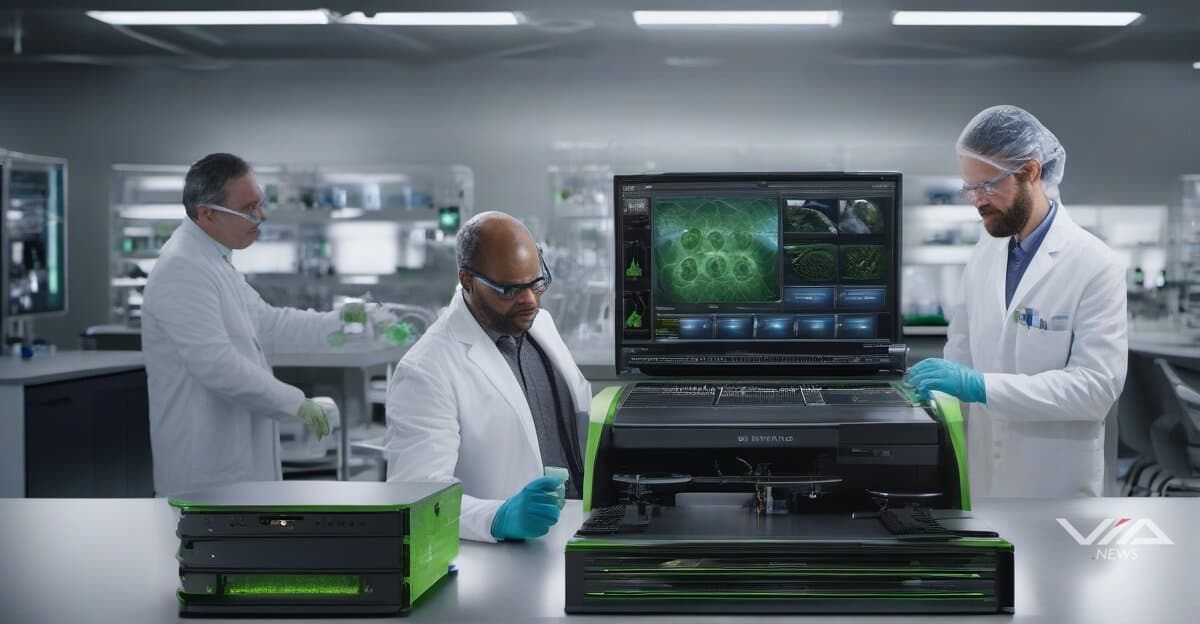
Image generated by AI for illustrative purposes. Not actual footage or photography from the reported events.

NVIDIA has secured partnerships with Eli Lilly and Thermo Fisher Scientific for its BioNeMo platform, positioning the AI infrastructure as essential middleware for pharmaceutical drug discovery workflows.

BioNeMo serves as the foundational layer connecting AI compute resources to autonomous laboratory operations. The platform targets the gap between general-purpose AI hardware and specialized scientific applications, creating a defensible position through domain-specific tooling.

The Eli Lilly collaboration represents a major pharmaceutical company integrating NVIDIA's infrastructure into core research operations. Thermo Fisher's adoption extends BioNeMo's reach into laboratory equipment and workflow automation, where the platform can interface directly with physical scientific processes.

NVIDIA's strategy mirrors its broader playbook: provide the picks and shovels while others mine for gold. Rather than developing drugs directly, the company supplies the computational infrastructure that biotech startups and pharmaceutical giants use to accelerate discovery timelines.

The platform expansion enables a growing ecosystem of biotech AI startups that build on BioNeMo's foundation. These companies lack resources to develop proprietary AI infrastructure from scratch, making NVIDIA's domain-adapted tools essential for market entry.

This vertical integration into scientific domains creates moats beyond raw compute performance. BioNeMo embeds NVIDIA deeper into customer workflows through specialized molecular modeling, protein structure prediction, and drug interaction simulation capabilities tailored for pharmaceutical research.

The pharmaceutical partnerships validate NVIDIA's thesis that AI infrastructure companies can capture value in specialized sectors by providing the middleware layer. As drug discovery becomes increasingly computational, controlling the software stack between silicon and science offers recurring revenue beyond one-time hardware sales.

For NVIDIA shareholders, the BioNeMo traction signals diversification beyond data center GPU sales into sticky, application-specific platforms. Pharmaceutical R&D budgets represent a substantial addressable market where computational infrastructure spending continues expanding as AI adoption accelerates.

The coordinated platform play positions NVIDIA as the de facto standard for AI-enabled biotech infrastructure, similar to its dominance in autonomous vehicles and large language model training.

Source documents

Via News is a conduit. We point to the source documents behind this report — we don't replace them. Trace any claim to its source and decide what to trust. How we source

Source Trace Score1 source document1 with a live linkVerifiability: Basic
  1. [1]News articleYahoo Finance· January 12, 2026
    NVIDIA BioNeMo Platform Adopted by Life Sciences Leaders to Accelerate AI-Driven Drug Discovery

In this story · Knowledge Files

LM Salvado
LM Salvado

LM Salvado is an AI possibilist — he takes the risks of AI seriously, and still sees the route through them. Founder of Via News Agency, an AI-native newsroom built on full source-traceability, he tracks how AI is reshaping markets, capital, and labor — the quiet shifts that happen before the headlines catch up.

What we know · the intelligence behind this page
Live from the substrate
What we're seeing
The Agentic Takeover of the CFO's Office
Enterprise finance software vendors—BlackLine, OneStream, Numero AI, and Oracle—are racing to embed autonomous AI agents into core financial operations (close, consolidation, reporting), backed by consolidation M&A (Numero-Royu, BlackLine-WiseLayer), fresh leadership hires, and survey data showing nearly a quarter of CFOs plan to boost AI spending over 50%. Adoption momentum is strong even as at least one bellwether (Oracle) sees its stock lag year-to-date, suggesting the market hasn't yet fully priced in the shift from AI-as-feature to AI-as-agent in finance.
Our read on the data ›
Signals we're tracking
Satellite-Terrestrial Network Integration Acceleration
Increased investment and launches in hybrid satellite-cellular networks across telecom industry; competitive responses from other carriers; regulatory activity around satellite spectrum; expansion of emergency/rural connectivity use cases
Patterns we're watching ›
Where sources disagree
Morgan Stanley & Co. LLC
Two significantly different EPS values (10.21 vs 2.68 USD_per_share) are reported for Morgan Stanley on the same observation date (2025-12-31). Fact A specifies FY 2025, while Fact B's 'N/A' fiscal period is ambiguous. If both represent FY 2025 annual EPS, these values directly conflict. The magnitude of the difference (3.8x) is too large to attribute to rounding or minor calculation variations. The missing fiscal period in Fact B raises data quality concerns, but same-date observation + same attribute should reference the same period.
We flag conflicts openly ›
Recently verified
✓ Checked against the original source
4,984
facts traced to their source — and we flag the ones that don't hold up.
101 entities tracked4,984 facts checked against source5,314 source documents archived
Query this data → isubstrate.com