Monday, October 12, 2026

Tech Companies Pour Billions Into Nuclear Partnerships as AI Data Centers Demand Reliable Power

Meta struck three nuclear energy deals in January 2026 while the Trump administration launched an AI power initiative, signaling a strategic shift in how tech giants secure electricity for AI infrastructure. Energy stocks surged as investors bet on sustained demand from data center expansion.

Tech Companies Pour Billions Into Nuclear Partnerships as AI Data Centers Demand Reliable Power
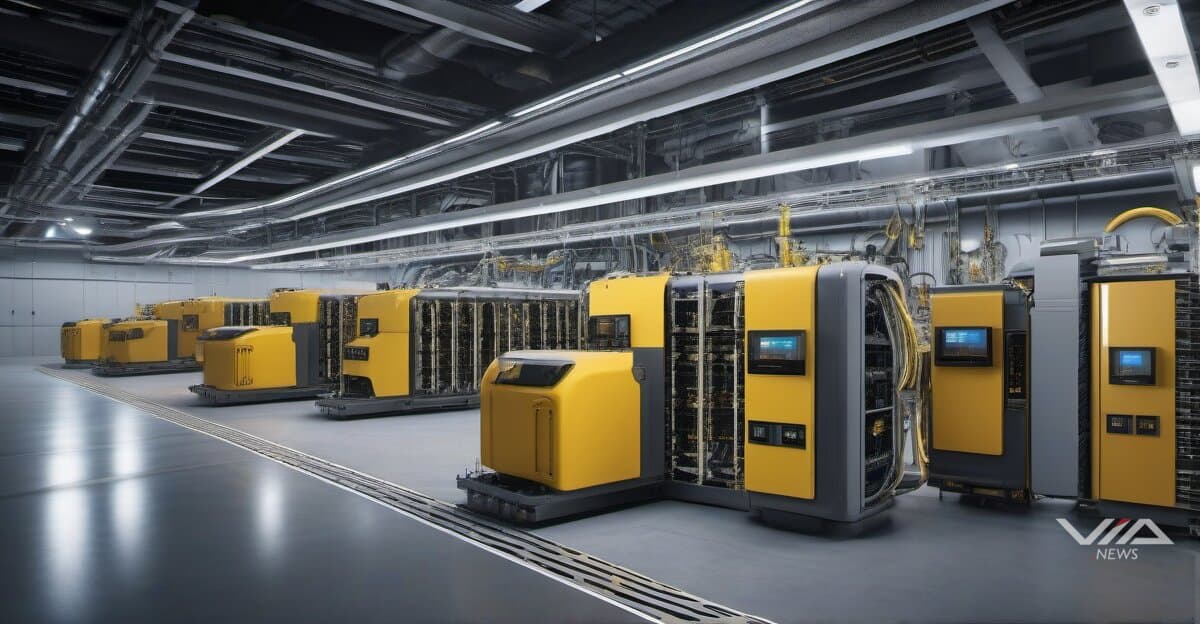
Image generated by AI for illustrative purposes. Not actual footage or photography from the reported events.

Meta signed three separate nuclear energy agreements on January 1, 2026, marking the most aggressive move yet by a tech company to lock in power for AI operations. The Trump administration announced a matching initiative the same day to accelerate private-sector AI power deals.

The partnerships follow a pattern. DMG began pursuing partners for its Christina Lake AI data center in December 2025. Westinghouse secured a U.S. government contract for nuclear reactors the same month. GE Vernova raised its long-term financial guidance on December 9, 2025, with shares up 260% since its April 2024 spinoff.

Nuclear power offers two advantages for AI workloads: constant baseline output and zero carbon emissions. Training large language models requires sustained electricity loads that solar and wind cannot reliably provide. A single data center can consume 100-300 megawatts continuously.

Tech companies now allocate capital expenditure to energy infrastructure directly rather than relying on utility contracts. This shift reduces exposure to grid constraints and regulatory delays. Meta's deals likely involve long-term power purchase agreements or direct investment in reactor construction.

Energy sector stocks reflect investor confidence in sustained demand. GE Vernova's guidance increase came as orders for gas turbines and grid equipment accelerated. Nuclear equipment manufacturers and uranium miners saw share price gains through Q4 2025.

The correlation between AI announcements and energy partnerships has tightened over six months. Each major data center project now includes explicit power sourcing plans. Companies that secure energy first gain competitive advantage in AI infrastructure deployment.

The Trump administration's initiative suggests regulatory support for expedited nuclear permitting. Small modular reactors (SMRs) could reduce construction timelines from 10 years to 5 years, making them viable for tech company planning horizons.

Investment banks project $50-100 billion in tech-to-energy capital flows through 2030 as AI training demands grow. Companies without power agreements face delays in deploying next-generation models.

What we know · the intelligence behind this page
Live from the substrate
What we're seeing
Agentic AI Rewires Enterprise Software: Platform Incumbents, Governance, and a Funded Startup Wave
Enterprise software is being rebuilt around autonomous AI agents. Incumbents and large platforms (SAP with its Autonomous Suite and Joule, Zeta with AthenaOS/AIM/Athena MCP, Meta with its new Enterprise Platform) are racing to own the agent layer. Meanwhile, seed and Series A money flows to finance-office and vertical startups (Dextr, Latitude, Dentira, Light), and consolidation continues through acquisitions (Tiny–Oso Cloud, Harvey–Guardrails AI). Investor commentary stresses that AI is better at disrupting around the edges of systems of record than at replacing them, that it should not be trusted with finance calculations, and that governance must be enforced by the system rather than left to agents.
Our read on the data ›
Signals we're tracking
EPKINLY Regulatory-Clinical Success Cascade
High probability of expanded label indications, additional combination approvals, and competitive positioning strength in follicular lymphoma market. Predicts positive commercial uptake and potential accelerated review for related indications.
Patterns we're watching ›
Where sources disagree
ING Group
Both facts record the same metric (shares_outstanding) for ING Group at the identical observation date (2025-12-31). FACT A states 2,902,437,688 shares; FACT B states 2,902 million shares (2,902,000,000). The difference is 437,688 shares (~0.015%). This is a genuine value conflict, though the discrepancy appears to result from FACT B rounding to the nearest million while FACT A provides the precise count.
We flag conflicts openly ›
Recently verified
✓ Checked against the original source
4,986
facts traced to their source — and we flag the ones that don't hold up.
101 entities tracked4,986 facts checked against source5,369 source documents archived
Query this data → isubstrate.com