
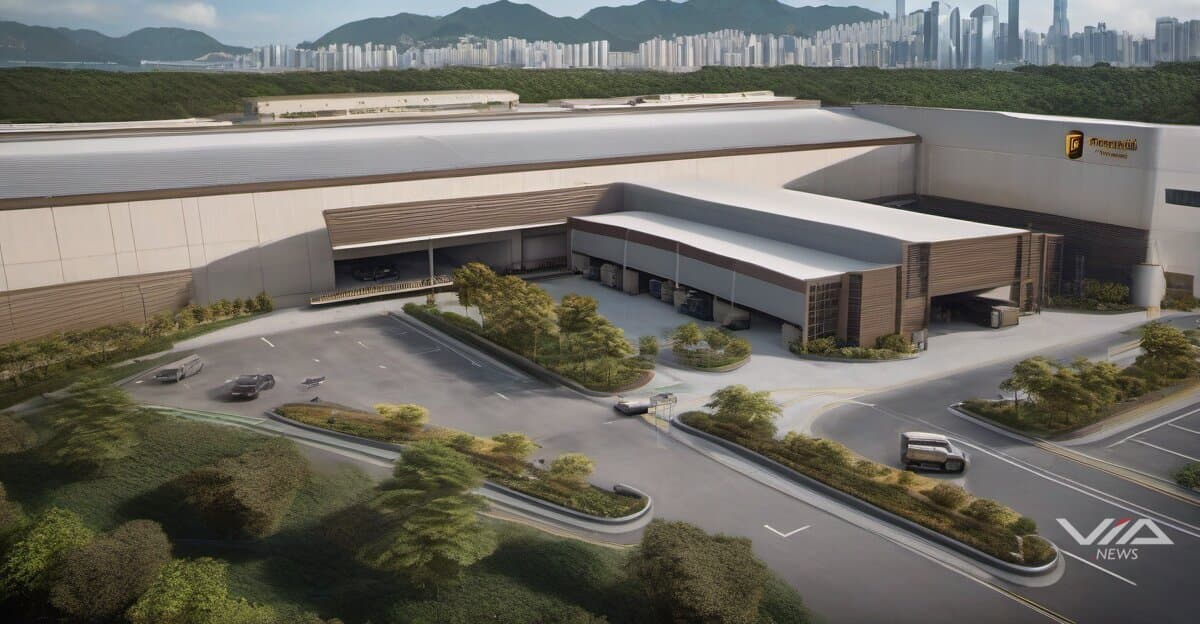
United Parcel Service is moving forward with an expansion of its gateway facility in Hong Kong, a capital commitment that underscores the logistics giant's conviction that Asia-Pacific remains a critical corridor for global supply chains — even as the company simultaneously executes one of the most aggressive cost-reduction programs in its history.
The Hong Kong facility expansion, flagged during UPS's Q4 2025 earnings call on January 27, 2026, forms part of the company's international infrastructure buildout at a moment when its near-term Asia trade volumes are under pressure. U.S. import volumes from the region fell sharply in Q4 2025, with China-origin shipments down 20.9% year-over-year and Canada/Mexico corridor volumes off 30.5%.
Yet rather than retrenching, UPS appears to be playing a longer game. Hong Kong's position as a transshipment and financial hub gives the gateway facility strategic value beyond point-to-point China-U.S. flows — particularly as multinational corporations diversify supply chains across Southeast Asia, including Vietnam, Malaysia, and India.
Infrastructure Investment Amid Financial Discipline
The Hong Kong expansion comes as UPS reshapes its capital allocation profile. The company reported full-year 2025 capital expenditure of $3.7 billion, with guidance for 2026 calling for a reduction to approximately $3 billion. Against that backdrop, committing funds to Asia-Pacific gateway infrastructure signals where management sees the highest-return opportunities.
UPS generated $8.5 billion in cash from operations in 2025 and is targeting free cash flow of approximately $6.5 billion in 2026 — providing the financial headroom to fund both shareholder returns and selective infrastructure investment simultaneously. The company returned $6.4 billion to shareholders in 2025 through dividends and buybacks.
International operations delivered a 15.8% operating margin for the full year 2025, the strongest of UPS's three reporting segments and a meaningful premium over the 7.7% margin recorded in U.S. Domestic. Q4 international revenue reached $5 billion, up 2.5% year-over-year, though operating profit dipped $154 million as costs weighed on the quarter.
Asia-Pacific Supply Chain Context
The Hong Kong gateway investment is particularly notable given the structural shifts underway in global supply chains. Corporate procurement teams have spent the past several years reducing single-source dependence on Chinese manufacturing, redistributing production capacity across the Asia-Pacific region. That diversification creates new logistics complexity — and new revenue opportunities for carriers with regional hub infrastructure.
For UPS's international segment, 2026 guidance calls for low single-digit revenue growth and a mid-teens operating margin, suggesting management expects the segment's profitability profile to remain robust even as volume growth moderates. Q1 2026 is expected to be the softest quarter, with operating profit projected down approximately 30% year-over-year before conditions improve.
UPS President of International Kathleen Gutmann has positioned the company's healthcare logistics capabilities as a key differentiator in Asia, where pharmaceutical and cold-chain demand continues to expand. The Hong Kong facility, as a gateway node, is well-positioned to serve both traditional e-commerce flows and higher-margin healthcare logistics.
Strategic Implications
For investors assessing UPS's capital deployment discipline, the Hong Kong expansion represents a measured, targeted bet rather than broad-based regional overexpansion. It reflects a calculation that Asia-Pacific supply chain complexity will persist — and that purpose-built gateway infrastructure in a financially sophisticated hub city carries durable competitive value regardless of near-term volume fluctuations driven by tariff policy or bilateral trade dynamics.
With $3 billion in planned 2026 capex and a free cash flow target of $6.5 billion, UPS has the balance sheet flexibility to pursue such investments without compromising its dividend commitment of approximately $5.4 billion — a combination that positions the company to emerge from its current restructuring cycle with both a leaner cost base and a stronger international footprint.