Sunday, September 27, 2026

Data Center Operators Deploy Liquid Cooling and Next-Gen Interconnects for AI Workloads

Infrastructure providers are installing liquid cooling systems and upgrading to 224G retimers and AI-Scale Ethernet to handle AI training clusters. Companies like Supermicro and Nokia are shipping AI-native systems with optical scale-up capabilities. The shift addresses bandwidth and thermal constraints that traditional air-cooled data centers cannot solve at scale.

Source Trace Score12 source documents12 with a live linkVerifiability: Strong
Data Center Operators Deploy Liquid Cooling and Next-Gen Interconnects for AI Workloads
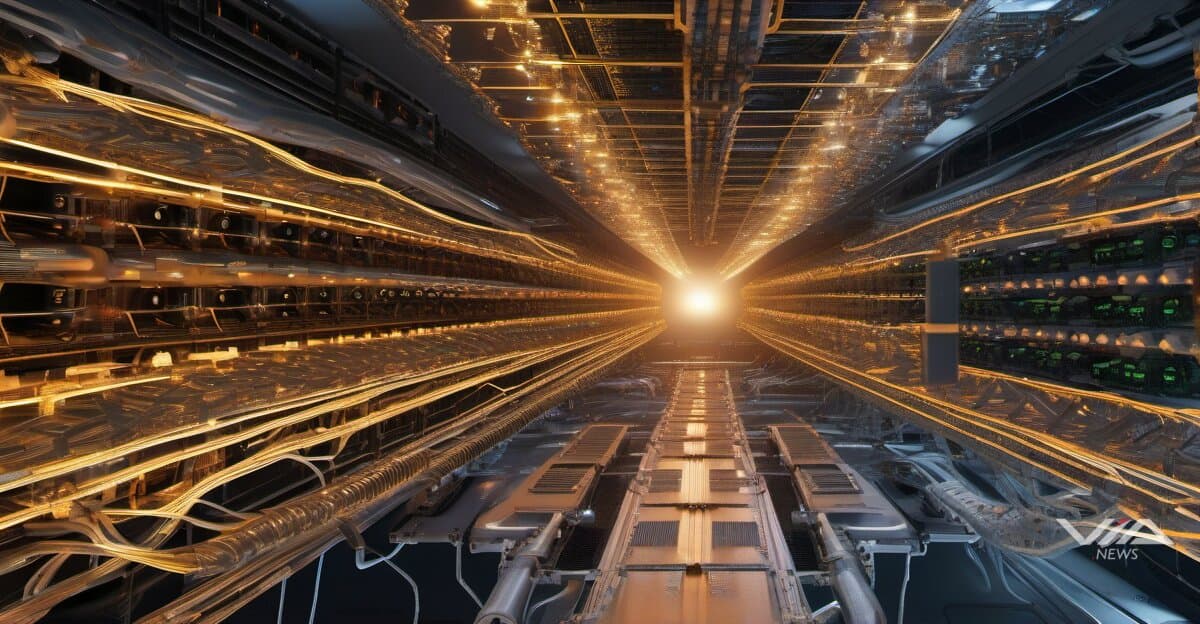
Image generated by AI for illustrative purposes. Not actual footage or photography from the reported events.

Data center operators are installing liquid cooling infrastructure and next-generation network interconnects to support AI compute demands that exceed traditional architecture limits.

Supermicro is delivering Red Hat-certified systems with NVIDIA accelerators designed for AI factories. "Our validated solutions for the Red Hat AI Factory with NVIDIA help ensure that customers can combine our high-performance, purpose-built systems with a robust, enterprise-grade software platform," said Vik Malyala, executive at Supermicro.

Network providers are deploying AI-Scale Ethernet and 224G retimers to eliminate bandwidth bottlenecks in training clusters. Nokia is integrating AI-RAN capabilities to distribute intelligence across network layers. "Physical AI requires an intelligent network underpinned by AI-RAN so operators can fully harness distributed intelligence across every layer of the network," said Ronnie Vasishta at Nokia.

Cooling innovation extends to marine environments. Offshore data centers use seawater for thermal management, though saltwater introduces corrosion and fouling challenges. "The marine environment is pretty brutal to engineer around because there's the increased salinity, there's debris, and various kinds of corrosion and fouling of metal piping," said Daniel King, analyzing underwater deployments.

Edge computing platforms are adopting new security frameworks. Veea Inc. open-sourced Lobster Trap, a scanning system that operates under one millisecond. The company launched TerraFabric for AI deployment at network edges. "Based on large scale deployments to date, we believe this allows organizations to accelerate updates and deploy new capabilities without compromising overall system stability," Veea stated.

The infrastructure buildout reflects capital reallocation from traditional server farms to AI-optimized facilities. Optical scale-up architectures and purpose-built cooling represent multi-billion dollar commitments that will reshape data center economics over the next investment cycle.

Source documents

Via News is a conduit. We point to the source documents behind this report — we don't replace them. Trace any claim to its source and decide what to trust. How we source

Source Trace Score12 source documents12 with a live linkVerifiability: Strong
  1. [1]News articleYahoo Finance· February 24, 2026
    Agentic AI Foundation Welcomes 97 New Members As Demand for Open, Collaborative Agent Standardization Increases
  2. [2]Press releaseGlobeNewswire· February 26, 2026
    DMG Blockchain Solutions Reports First Quarter 2026 Financial Results
  3. [3]News articleYahoo Finance· March 1, 2026
    Linux Foundation Announces OCUDU Ecosystem Foundation to Accelerate Open Source AI-RAN Innovation
  4. [4]Press releaseGlobeNewswire· March 1, 2026
    Nokia accelerates AI-RAN momentum with new partnerships driving path to AI-Native 6G #MWC26
  5. [5]News articleYahoo Finance· March 1, 2026
    NVIDIA and Global Telecom Leaders Commit to Build 6G on Open and Secure AI-Native Platforms
  6. [6]News articleYahoo Finance· February 24, 2026
    Red Hat AI Factory with NVIDIA Accelerates the Path to Scalable Production AI
  7. [7]News articleIEEE Spectrum
    This Offshore Wind Turbine Will House a Data Center Underwater
  8. [8]Press releaseGlobeNewswire· February 26, 2026
    Veea Inc. Launches TerraFabric, Paving the Way to Operate AI and Autonomous Systems at the Edge
  9. [9]Press releaseGlobeNewswire· March 2, 2026
    Veea Inc. Open-Sources Lobster Trap and Partners with NativelyAI to Advance Secure Agent Deployment
  10. [10]Press releaseGlobeNewswire· March 1, 2026
    Veea Platform Solution to Address Cybersecurity Challenges Nationwide for Businesses in Mexico
  11. [11]News articleYahoo Finance· March 3, 2026
    AI-Scale Ethernet at the Heart of Ethernet Alliance’s OFC 2026 Demo
  12. [12]News articleYahoo Finance· March 3, 2026
    ASM reports Q4 and full-year 2025 results
What we know · the intelligence behind this page
Live from the substrate
What we're seeing
Vertical AI Agents Attract a Funding Wave Across Fintech-Adjacent Industries
A cluster of AI-native startups applying autonomous agents to narrow, operational problems — hotel front-desk staffing (Dextr AI), identity/fraud risk for financial institutions (Baselayer), insurance distribution (Napo, Connie Health, MGT Insurance) — closed seed-to-Series A rounds within days of each other in September 2026, with CB Insights running a coordinated CEO interview series to spotlight them. The pattern points to agentic AI maturing from generic chat tools into vertical, revenue-generating products, with identity verification for AI agents themselves (Baselayer) emerging as a new fintech infrastructure category responding directly to AI-driven fraud risk.
Our read on the data ›
Signals we're tracking
Satellite-Terrestrial Network Integration Acceleration
Increased investment and launches in hybrid satellite-cellular networks across telecom industry; competitive responses from other carriers; regulatory activity around satellite spectrum; expansion of emergency/rural connectivity use cases
Patterns we're watching ›
Where sources disagree
ING Group
Both facts record the same metric (shares_outstanding) for ING Group at the identical observation date (2025-12-31). FACT A states 2,902,437,688 shares; FACT B states 2,902 million shares (2,902,000,000). The difference is 437,688 shares (~0.015%). This is a genuine value conflict, though the discrepancy appears to result from FACT B rounding to the nearest million while FACT A provides the precise count.
We flag conflicts openly ›
Recently verified
✓ Checked against the original source
4,984
facts traced to their source — and we flag the ones that don't hold up.
101 entities tracked4,984 facts checked against source5,306 source documents archived
Query this data → isubstrate.com