Friday, October 2, 2026

Saudi Arabia Secures $15B in AI Infrastructure Deals from AWS, Google, and Nvidia

Saudi Arabia has locked in over $15 billion in AI infrastructure investments from major tech companies as part of its Vision 2030 diversification strategy. AWS committed $5.3 billion for a cloud region, Google Cloud and PIF announced a $10 billion AI hub, and Nvidia will supply 18,000 Blackwell AI chips through state-backed HUMAIN.

Saudi Arabia Secures $15B in AI Infrastructure Deals from AWS, Google, and Nvidia
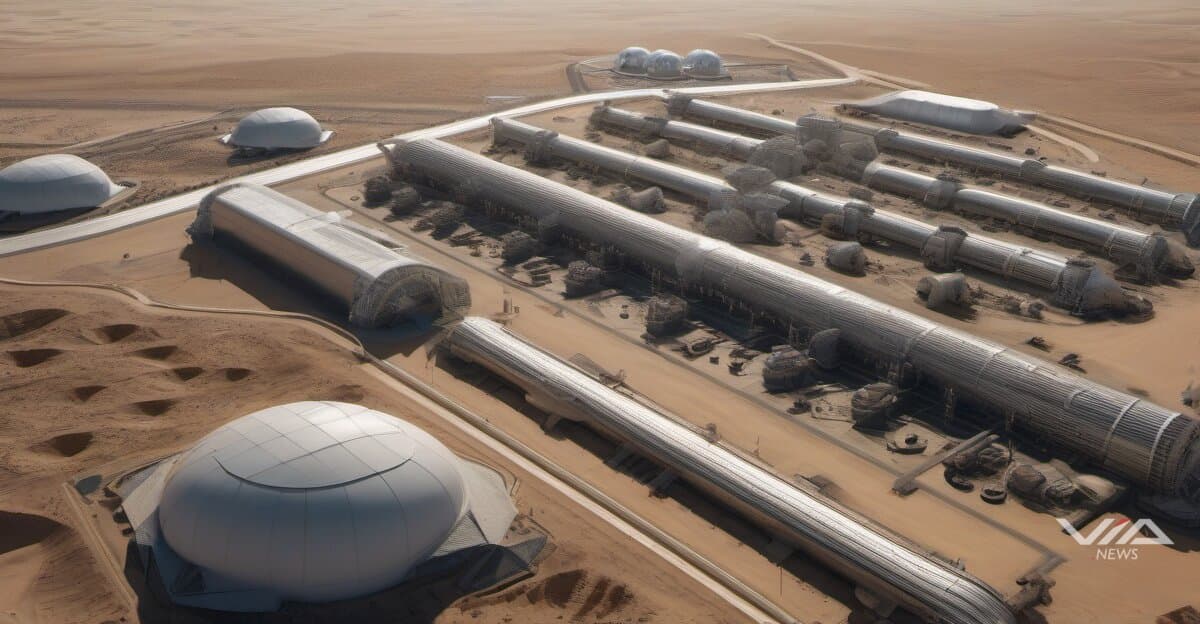
Image generated by AI for illustrative purposes. Not actual footage or photography from the reported events.

Saudi Arabia has secured over $15 billion in AI infrastructure commitments from AWS, Google Cloud, Nvidia, and AMD as the kingdom accelerates its push to become a regional AI hub by 2027.

AWS will invest $5.3 billion to build a cloud infrastructure region in Saudi Arabia. Google Cloud and the Public Investment Fund (PIF) announced a $10 billion partnership to establish an AI hub in the kingdom. Nvidia agreed to supply 18,000 Blackwell AI chips to HUMAIN, a government-backed AI company.

The investments mark Saudi Arabia's most aggressive tech sector push under Vision 2030, using oil revenues to build sovereign AI capabilities. HUMAIN, a subsidiary of the Saudi government, is leading chip procurement and model development efforts.

Saudi Arabia is considering converting portions of The Line, its planned linear city project, into AI data center facilities. The pivot would repurpose infrastructure in the Neom megaproject to house computing resources rather than residential developments.

The kingdom aims to compete with established AI centers in the United States and China within 24 months. Success metrics include research paper output from Saudi institutions, attracting R&D centers from major AI companies, releasing Saudi-trained large language models, and matching data center capacity growth rates in leading markets.

AMD has also signed AI chip supply agreements with Saudi entities, though financial terms were not disclosed. The combined hardware deals position Saudi Arabia to operate some of the Middle East's largest AI computing clusters.

The strategy faces execution risks. Building technical talent takes years, and data center construction timelines often slip. Saudi Arabia must also navigate U.S. export controls on advanced AI chips and compete for scarce engineering talent with higher-paying Western tech hubs.

PIF, Saudi Arabia's $700 billion sovereign wealth fund, is backing multiple AI initiatives beyond the Google partnership. The fund's involvement signals the government's commitment to deploying capital at scale to establish AI infrastructure before regional competitors.

The investments represent a calculated bet that sovereign AI capabilities will become strategic assets. Saudi Arabia is leveraging its financial resources to compress a decade of tech infrastructure development into a 24-month buildout.

In this story · Knowledge Files

What we know · the intelligence behind this page
Live from the substrate
What we're seeing
AI-Driven Drug Development Meets Biotech Deal-Making and Regulatory Catalysts
AI-designed therapeutics (Insilico's rentosertib showing biological-age reductions) are moving into the clinical mainstream. Large-cap biotech is simultaneously reallocating capital through M&A (Lilly–Merida, $2.9B) and government funding (BARDA–Basilea), while trial failures (ziltivekimab, a 9.4% Novo Nordisk share drop) and upcoming FDA catalysts (the ivonescimab PDUFA on 2026-11-14) drive volatility. The wider AI regulatory and legal climate (Tesla Cybercab probe, xAI's Minnesota loss, OpenAI suits) is tightening, though QAIAx's micro-cap trial claims are speculative and weakly connected.
Our read on the data ›
Signals we're tracking
Satellite-Terrestrial Network Integration Acceleration
Increased investment and launches in hybrid satellite-cellular networks across telecom industry; competitive responses from other carriers; regulatory activity around satellite spectrum; expansion of emergency/rural connectivity use cases
Patterns we're watching ›
Where sources disagree
ING Group
Both facts record the same metric (shares_outstanding) for ING Group at the identical observation date (2025-12-31). FACT A states 2,902,437,688 shares; FACT B states 2,902 million shares (2,902,000,000). The difference is 437,688 shares (~0.015%). This is a genuine value conflict, though the discrepancy appears to result from FACT B rounding to the nearest million while FACT A provides the precise count.
We flag conflicts openly ›
Recently verified
✓ Checked against the original source
4,985
facts traced to their source — and we flag the ones that don't hold up.
101 entities tracked4,985 facts checked against source5,327 source documents archived
Query this data → isubstrate.com