Monday, September 21, 2026

KLA Raises Revenue Guidance to $4B, Lifts 2026 Wafer Equipment Outlook to $150B Range

KLA Corporation raised its September-quarter revenue guidance to $4 billion and lifted its 2026 wafer fab equipment market outlook into the low $150 billion range. The company also raised its advanced packaging process control revenue target to $1.1 billion and announced a 10-for-1 stock split, signaling sustained AI-driven capital equipment demand.

LM Salvado
LM Salvado

August 3, 2026

KLA Raises Revenue Guidance to $4B, Lifts 2026 Wafer Equipment Outlook to $150B Range
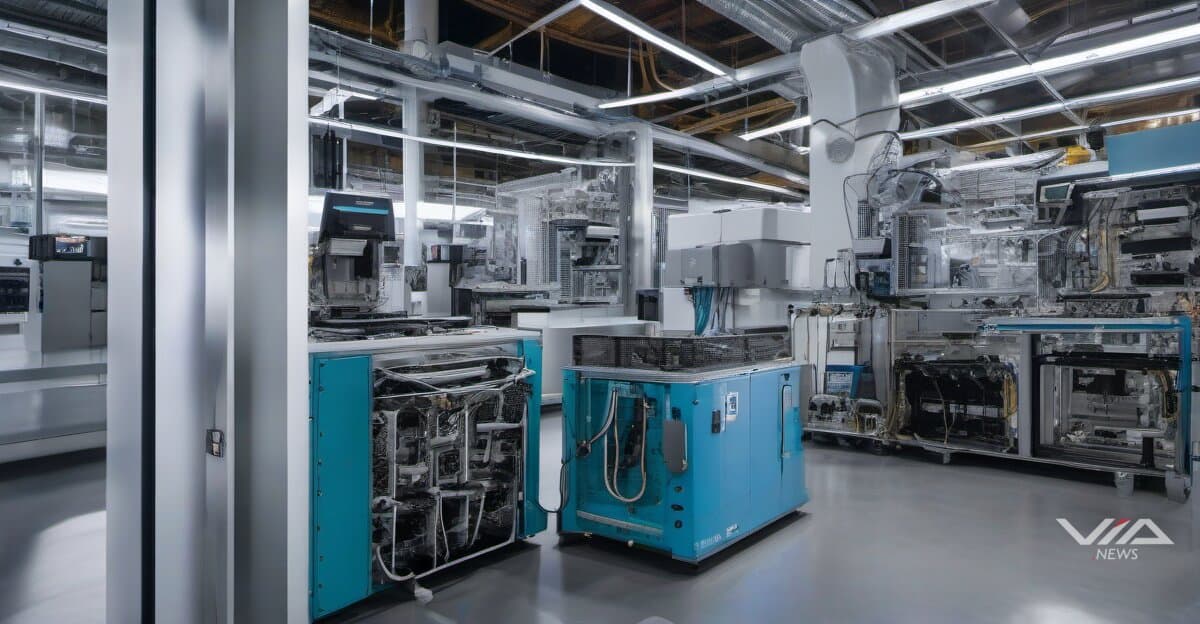
Image generated by AI for illustrative purposes. Not actual footage or photography from the reported events.

KLA Corporation raised its September-quarter revenue guidance to $4 billion.1 The company simultaneously lifted its 2026 wafer fab equipment market outlook to the low billions range.1 Both moves came in the same reporting cycle.

KLA also raised its advanced packaging process control revenue target to billions.1 The company announced a 10-for-1 stock split alongside the guidance increases.1 Three upward revisions and a split in one cycle point to confidence in near-term order volume, not just current bookings.

The guidance ties directly to AI accelerator and high-bandwidth memory (HBM) production.1 Advanced packaging and wafer equipment are core inputs for both. Chipmakers scaling AI accelerator output need more process control tools per wafer, and HBM stacking requires additional packaging inspection steps. KLA's targets reflect that build-out.

For enterprise semiconductor investment, the signal is continuation, not a one-time spike. A raised full-year market outlook implies equipment orders extend beyond the current quarter into 2026 spending plans. That matters for capital equipment pricing, which tends to firm when order backlogs lengthen.

The pattern likely extends to peer equipment makers. Applied Materials, Lam Research, and ASML serve overlapping customers in wafer fabrication and advanced packaging.1 If AI-driven capacity demand is broad-based rather than KLA-specific, comparable guidance raises from these peers would confirm a sector-wide upcycle rather than a single-company beat.

Investors should watch the next 1-2 quarters for corroborating guidance from equipment peers.1 A cluster of similar raises would indicate semiconductor capital spending is accelerating industry-wide, driven by AI chip fabrication needs rather than isolated order timing. Absent that confirmation, KLA's raise stands as a single data point rather than a market signal.

The stock split does not change company fundamentals but often precedes broader investor accessibility and trading volume shifts, which can amplify near-term price reaction to the guidance news.

In this story · Knowledge Files

About this analysis

This is a Via News analysis. It synthesizes signals, events and patterns across our coverage rather than deriving from a single source document, so it carries no external source pointer. Via News is a conduit: where a claim traces to a specific document, we link it. How we source

LM Salvado
LM Salvado

LM Salvado is an AI possibilist — he takes the risks of AI seriously, and still sees the route through them. Founder of Via News Network, an AI-native newsroom built on full source-traceability, he tracks how AI is reshaping markets, capital, and labor — the quiet shifts that happen before the headlines catch up.

What we know · the intelligence behind this page
Live from the substrate
What we're seeing
Frontier AI Slowdown Call Splits Industry, Rattles Capex-Sensitive Markets
Anthropic's Dario Amodei publicly called for a coordinated global slowdown in frontier AI development, a stance Microsoft echoed with a 'humanist' AI code of conduct, but Nvidia and Meta's CEOs rejected any coordinated pause days later, exposing a widening rift between safety-focused and growth-focused AI leaders. The dispute landed amid growing financial scrutiny of AI infrastructure spending — a hyperscaler capex analysis, FTC warnings against antitrust waivers for AI firms, and an 8.6% single-day stock drop in GE Vernova tied directly to the slowdown remarks — signaling investors are newly nervous about whether the AI capex boom (including Alphabet's projected $701B revenue narrative) can be justified if the pace of development itself becomes contested.
Our read on the data ›
Signals we're tracking
Satellite-Terrestrial Network Integration Acceleration
Increased investment and launches in hybrid satellite-cellular networks across telecom industry; competitive responses from other carriers; regulatory activity around satellite spectrum; expansion of emergency/rural connectivity use cases
Patterns we're watching ›
Where sources disagree
ING Group
Both facts record the same metric (shares_outstanding) for ING Group at the identical observation date (2025-12-31). FACT A states 2,902,437,688 shares; FACT B states 2,902 million shares (2,902,000,000). The difference is 437,688 shares (~0.015%). This is a genuine value conflict, though the discrepancy appears to result from FACT B rounding to the nearest million while FACT A provides the precise count.
We flag conflicts openly ›
Recently verified
Checked against the original source
4,983
facts traced to their source — and we flag the ones that don't hold up.
101 entities tracked4,983 facts checked against source5,304 source documents archived
Query this data → isubstrate.com