Sunday, September 27, 2026

Industrial Robot Sales Surge as Labor Constraints Drive $30B AI Infrastructure Buildout

Industrial automation robot sales jumped sharply in 2025, according to the International Federation of Robotics, as manufacturers respond to persistent labor shortages. The shift is fueling demand for AI-capable processors and edge computing hardware, with infrastructure provider CoreWeave planning to double capital spending to $30 billion in 2026.

Industrial Robot Sales Surge as Labor Constraints Drive $30B AI Infrastructure Buildout
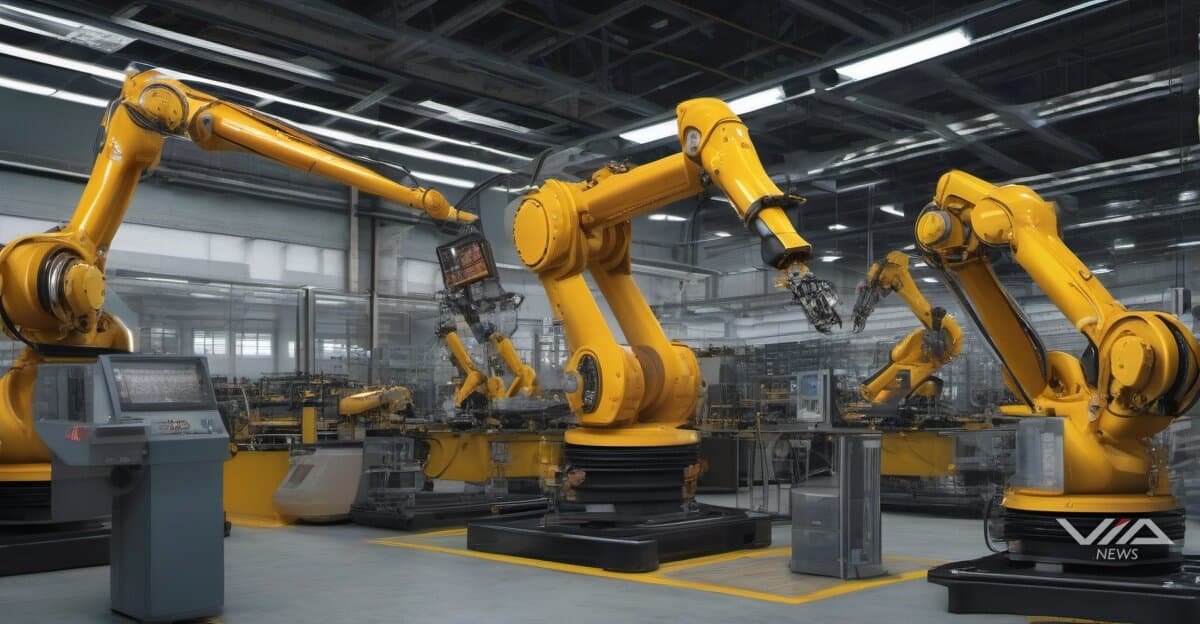
Image generated by AI for illustrative purposes. Not actual footage or photography from the reported events.

Industrial automation robot sales rose significantly in 2025, the International Federation of Robotics reported, as companies facing worker shortages turn to AI-enhanced automation. The trend is creating downstream demand for specialized computing hardware designed to power intelligent machines on factory floors.

CoreWeave projects capital expenditures will reach at least $30 billion in 2026, up from $15.4 billion in 2025, reflecting infrastructure investment to support AI workloads. Marvell Technology posted Q3 net revenue of $2.08 billion, indicating strong demand for data infrastructure components that enable automation systems.

AMD released its Ryzen AI 400 Series processors, the first chips designed specifically for Copilot+ AI experiences. "The desktop PC is evolving from tool to intelligent assistant," said Jack Huynh, AMD executive. The processors target edge computing applications where AI processing occurs locally rather than in centralized data centers.

The robotics buildout addresses two corporate pressures simultaneously: labor market tightness and operational cost control. Traditional automation handled repetitive tasks, but AI-enabled systems adapt to variable conditions without human intervention. This capability matters most in sectors where worker availability fluctuates or training costs remain high.

The shift creates investment opportunities in edge AI processors, which differ from cloud-focused chips. Factory automation requires real-time processing with minimal latency, driving demand for specialized hardware that handles AI inference locally. Companies supplying these components stand to benefit as manufacturers retrofit existing facilities and build new automated production lines.

Monitor industrial robot shipment volumes against edge AI processor sales to gauge adoption rates. The correlation between AI-enabled robotics deployment and infrastructure spending will indicate whether this trend sustains or represents a temporary spike driven by post-pandemic labor dynamics.

What we know · the intelligence behind this page
Live from the substrate
What we're seeing
Vertical AI Agents Attract a Funding Wave Across Fintech-Adjacent Industries
A cluster of AI-native startups applying autonomous agents to narrow, operational problems — hotel front-desk staffing (Dextr AI), identity/fraud risk for financial institutions (Baselayer), insurance distribution (Napo, Connie Health, MGT Insurance) — closed seed-to-Series A rounds within days of each other in September 2026, with CB Insights running a coordinated CEO interview series to spotlight them. The pattern points to agentic AI maturing from generic chat tools into vertical, revenue-generating products, with identity verification for AI agents themselves (Baselayer) emerging as a new fintech infrastructure category responding directly to AI-driven fraud risk.
Our read on the data ›
Signals we're tracking
Satellite-Terrestrial Network Integration Acceleration
Increased investment and launches in hybrid satellite-cellular networks across telecom industry; competitive responses from other carriers; regulatory activity around satellite spectrum; expansion of emergency/rural connectivity use cases
Patterns we're watching ›
Where sources disagree
ING Group
Both facts record the same metric (shares_outstanding) for ING Group at the identical observation date (2025-12-31). FACT A states 2,902,437,688 shares; FACT B states 2,902 million shares (2,902,000,000). The difference is 437,688 shares (~0.015%). This is a genuine value conflict, though the discrepancy appears to result from FACT B rounding to the nearest million while FACT A provides the precise count.
We flag conflicts openly ›
Recently verified
✓ Checked against the original source
4,984
facts traced to their source — and we flag the ones that don't hold up.
101 entities tracked4,984 facts checked against source5,306 source documents archived
Query this data → isubstrate.com