Tuesday, August 18, 2026
What we know · the intelligence behind this page
Live from the substrate
What we're seeing
Enterprise AI Agent Rollout Outpaces Data Trust and Readiness
Enterprise adoption of agentic AI is accelerating fast — Siemens deepening its NVIDIA partnership for self-verifying agentic AI in chip design, Manulife expanding its Microsoft AI-governance partnership, and a wave of infrastructure launches (NVIDIA GPU-accelerated data processing, Dell exascale storage, new AI chip generations) — even as a new Google Cloud survey shows the underlying data foundation isn't ready: companies have AI access to only 45% of their data on average, data laggards see access fall to 30% or less, and only about half of organizations trust their AI agents' decisions. Meanwhile, insider selling at enterprise-AI bellwether C3.ai (CEO Thomas Siebel offloading $4.8M in shares) hints at investor caution layered under the adoption hype.
Our read on the data ›
Signals we're tracking
Satellite-Terrestrial Network Integration Acceleration
Increased investment and launches in hybrid satellite-cellular networks across telecom industry; competitive responses from other carriers; regulatory activity around satellite spectrum; expansion of emergency/rural connectivity use cases
Patterns we're watching ›
Where sources disagree
JPMorgan Chase & Co.
Both facts report JPMorgan Chase & Co.'s revenue for the same fiscal period (FY 2025) with the same observation date (2025-12-31), but with different values: $182.447 billion vs. $185 billion. The ~1.4% difference ($2.553 billion) is too large to be explained by rounding alone and represents conflicting data for the identical time period.
We flag conflicts openly ›
Recently verified
Checked against the original source
4,812
facts traced to their source — and we flag the ones that don't hold up.
101 entities tracked4,812 facts checked against source5,219 source documents archived
Work with this data → vianewsagency.com

Great Vision HK Express faces revenue collapse from 50% transpacific volume drop and air cargo loss

Great Vision HK Express confronts a catastrophic revenue threat as transpacific shipping volumes plunge 50% while air cargo capacity evaporates. The e-commerce logistics provider, heavily dependent on China-North America trade routes, faces combined pressures that could threaten its business viability.

Great Vision HK Express faces revenue collapse from 50% transpacific volume drop and air cargo loss
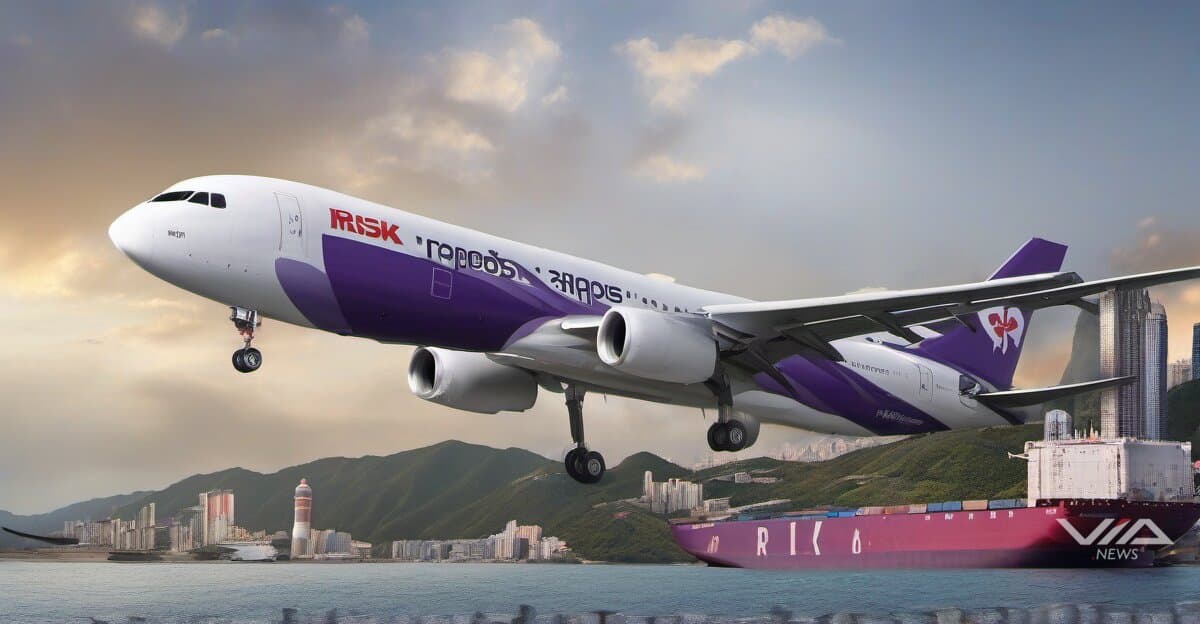
Image generated by AI for illustrative purposes. Not actual footage or photography from the reported events.

Great Vision HK Express is experiencing a catastrophic revenue collapse driven by a 50% decline in transpacific shipping volumes and simultaneous loss of air cargo capacity. The dual blow threatens the viability of the e-commerce logistics provider, which specializes in China-North America trade routes.

The volume decline reflects broader deterioration in transpacific e-commerce flows. Chinese logistics firms serving cross-border merchants have seen demand crater as U.S.-China trade tensions and shifting consumer behavior reduce eastbound shipments. Great Vision's concentration on this corridor leaves little room to pivot.

Air cargo capacity loss compounds the crisis. Freight forwarders like Great Vision depend on reliable air cargo access to serve time-sensitive e-commerce shipments. Global air cargo capacity constraints—driven by aircraft availability, route reductions, and increased freight rates—have squeezed margins while reducing service reliability.

The combined impact creates a revenue vise. Lower volumes reduce top-line sales while lost air cargo capacity eliminates higher-margin express services. Fixed costs for warehousing, staff, and infrastructure remain constant even as revenue falls, accelerating cash burn.

Great Vision's business model assumed steady transpacific e-commerce growth. That assumption now appears broken. Chinese cross-border sellers face headwinds from U.S. tariff policies, regulatory scrutiny of platforms like Temu and Shein, and consumer pullback on discretionary goods. North American importers are diversifying supply chains away from China toward Vietnam, Mexico, and other markets.

The freight forwarding sector is consolidating. Smaller players without geographic diversification or multimodal capabilities face existential pressure. Great Vision's niche focus—once a competitive advantage—now limits strategic options. Competitors with ocean freight, European routes, or domestic Chinese logistics can offset transpacific weakness.

Recovery prospects depend on factors outside Great Vision's control: trade policy shifts, air cargo capacity expansion, and renewed e-commerce demand. Without a swift reversal, the company faces difficult choices including asset sales, merger negotiations, or restructuring. The 70% confidence assessment reflects uncertainty around timing and severity, but the trajectory is clear: Great Vision's current model cannot sustain a 50% volume loss.