
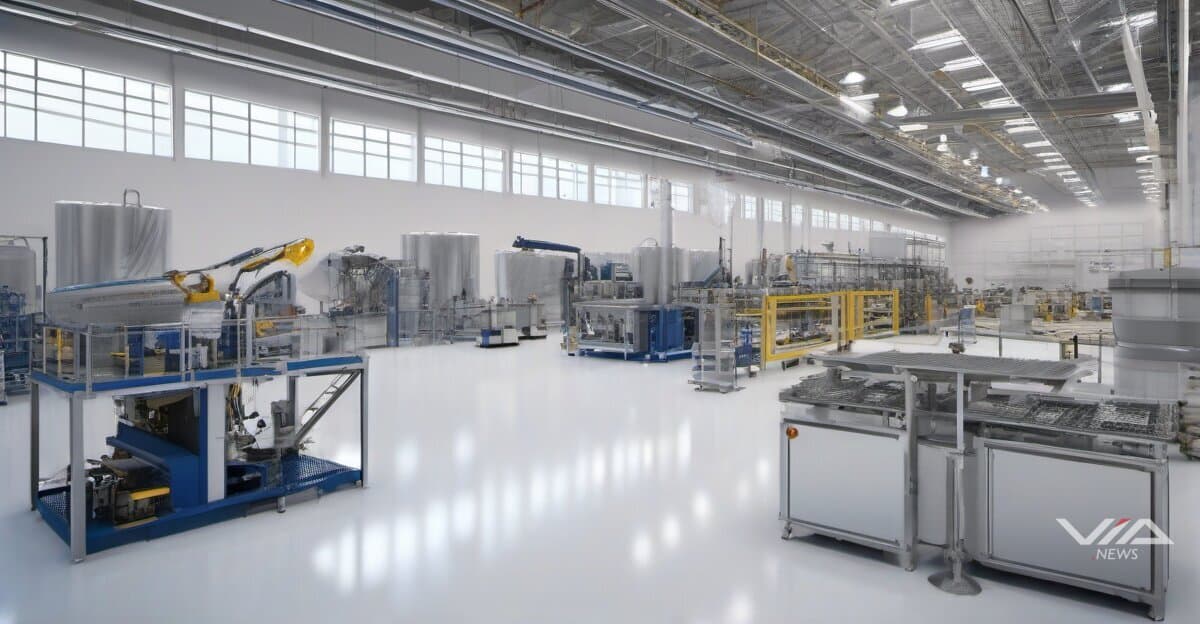
When production kicks off at Amkor Technology's massive Arizona campus — projected to begin in 2028 — it will mark a defining moment for the U.S. semiconductor industry's long-running effort to rebuild advanced manufacturing capacity on domestic soil.
The facility, anchored by approximately 750,000 square feet of cleanroom space, is among the largest semiconductor packaging investments ever undertaken on American soil. For investors and financial analysts tracking capital flows in the chip sector, the scale of the buildout underscores just how seriously the industry is treating supply chain resilience as a structural, not cyclical, priority.
A Capital-Intensive Bet on Domestic Packaging
Amkor, the world's second-largest outsourced semiconductor assembly and test (OSAT) provider, has positioned the Peoria, Arizona campus as a cornerstone of its long-term North American strategy. The company has publicly indicated total investment in the facility could reach into the billions of dollars over the coming years, with significant funding support anticipated from the U.S. CHIPS and Science Act — the landmark 2022 legislation that allocated over $52 billion to revitalize American semiconductor production.
The financial logic is compelling. Advanced packaging — which includes technologies such as fan-out wafer-level packaging, 2.5D interposers, and chiplet integration — has become a critical differentiator in the performance of leading-edge chips used in artificial intelligence, high-performance computing, and 5G infrastructure. Historically, this work has been concentrated in Taiwan, South Korea, and Malaysia, leaving U.S.-based chip designers heavily dependent on overseas assembly capacity.
Market Context: A Growing Sector
The timing aligns with robust structural growth in the broader wafer processing and dicing services market. Industry analysis projects the global wafer dicing services market will exceed $932.9 million by 2035, driven by surging demand for smaller, more powerful semiconductor components. Advanced packaging sits at the intersection of this growth, as die sizes shrink and multi-chip module architectures proliferate.
For Amkor specifically, a domestic U.S. facility allows the company to serve hyperscaler customers — think major cloud providers and AI chip designers — who face increasing political and regulatory pressure to source from geopolitically secure supply chains. Apple, one of Amkor's most significant customers, has itself been publicly supportive of the Arizona campus, signaling the kind of anchor-customer dynamic that de-risks the capital deployment for investors.
Investor and Policy Implications
From a capital markets perspective, the Arizona investment reflects a broader repricing of supply chain risk that has reshaped semiconductor sector valuations since the global chip shortage of 2021–2022. Companies able to offer advanced packaging services with domestic or allied-nation footprints are increasingly commanding premium positioning in customer procurement decisions.
The CHIPS Act framework means a portion of Amkor's capital expenditure may be offset by federal grants and tax incentives, improving the risk-adjusted return profile of the investment. Analysts have noted that OSAT companies with U.S. facilities stand to benefit disproportionately as the legislation's provisions take fuller effect through the late 2020s.
As the 2028 production start date approaches, the Arizona campus will serve as a bellwether — not only for Amkor's own revenue diversification strategy, but for the viability of high-complexity semiconductor manufacturing returning to American shores at meaningful scale.