
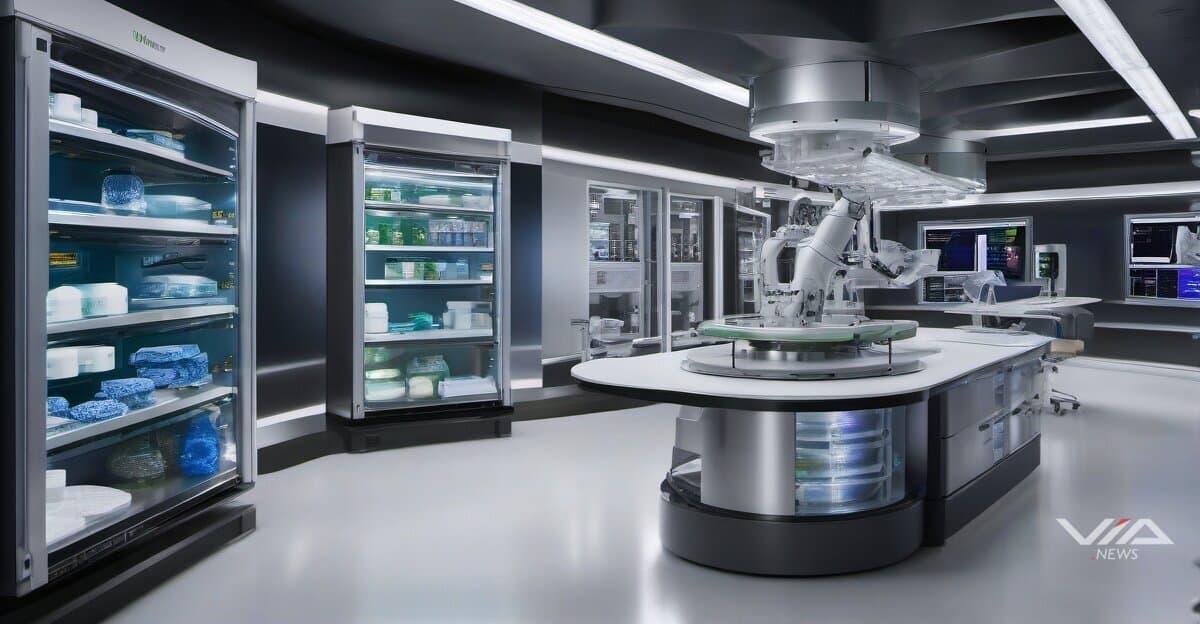
A strategic alliance forming at the intersection of semiconductor power, pharmaceutical capital, and artificial intelligence is reshaping how the drug discovery industry allocates resources — and where the next generation of biotech value is being built.
NVIDIA's BioNeMo platform, the company's specialized AI framework for biological and molecular research, has emerged as the focal point of this convergence. High-profile partnerships with Eli Lilly, one of the world's largest pharmaceutical companies by market capitalization, and Thermo Fisher Scientific, the dominant supplier of laboratory instruments and life science tools, represent more than product integrations. They signal that legacy institutions are now committing infrastructure budgets to AI-native workflows — a threshold moment for the sector.
Institutional Validation Drives Capital Reallocation
For financial observers, the significance of these partnerships lies less in their technical specifications than in what they communicate to capital markets. When a company of Eli Lilly's scale — which posted over $45 billion in revenue in 2024 driven substantially by its GLP-1 franchise — publicly aligns its R&D infrastructure with NVIDIA's AI stack, it establishes a benchmark. Peers, competitors, and the venture capital ecosystem all recalibrate their assumptions about which platforms will define the next decade of pharmaceutical development.
Thermo Fisher's involvement adds a second dimension: laboratory automation. The company's distribution reach into thousands of research institutions means that BioNeMo integration could propagate rapidly through academic and commercial research environments, accelerating adoption beyond what direct pharma partnerships alone could achieve.
A Maturing Ecosystem of Specialized Models
The NVIDIA-anchored partnerships are not occurring in isolation. A concurrent wave of specialized biotech AI model launches has broadened the competitive and investment landscape considerably. Companies including Natera (genomics and liquid biopsy), Basecamp Research (biodiversity-derived protein data), Boltz (biomolecular structure prediction), Owkin (federated learning for clinical data), and Edison Scientific are deploying foundation models tailored to specific biological domains.
This proliferation suggests the sector is transitioning from experimental AI adoption toward what analysts might characterize as infrastructure standardization — the phase in any technology cycle when platform bets begin to determine long-term competitive positioning. For life sciences venture capital, that transition carries direct portfolio implications: early-stage companies building on established AI platforms may carry lower technical risk, while those attempting to build proprietary model infrastructure face steeper capital requirements and longer timelines to validation.
Investment Implications for 2026 and Beyond
The structural shift underway has clear implications across asset classes. At the platform layer, NVIDIA's positioning in life sciences AI adds a durable growth vector that complements its dominance in data center and autonomous systems — a consideration for equity investors assessing long-term revenue diversification.
For biotech-focused funds, the emergence of BioNeMo as potential standard infrastructure raises the stakes of platform selection. Startups and mid-cap biotechs that integrate early with validated AI stacks may achieve faster IND filings and reduced preclinical attrition, metrics that directly influence Series B and C valuations.
Thermo Fisher's strategic positioning also warrants attention from healthcare equipment and services investors. If laboratory automation increasingly runs on AI-native software layers, the company's hardware distribution network becomes a deployment channel for software-driven recurring revenue — a margin-accretive evolution from its traditional instruments business model.
With investment and partnership activity accelerating into 2026, the convergence of hyperscaler compute, pharma incumbents, and AI-native startups is no longer a thesis. It is becoming observable infrastructure — and the capital following it is institutional in scale.