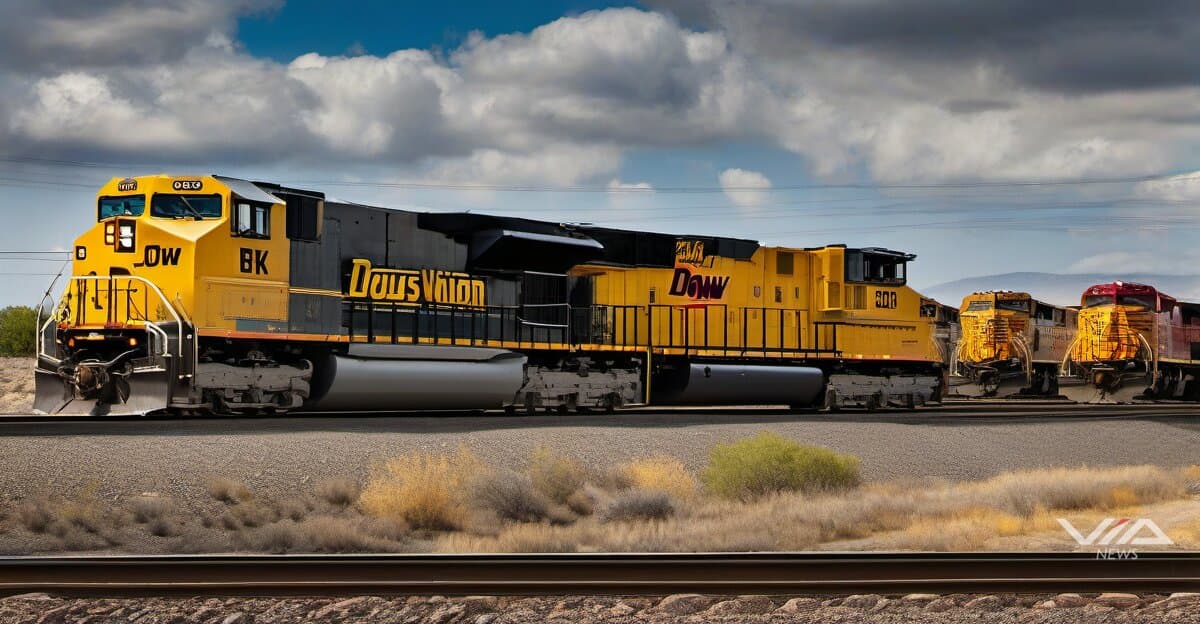
Two of America's largest capital-intensive companies reported on the same day, October 22, 2026, and told close to opposite stories about how to grow. Dow is shrinking its cost base to rebuild profit. Union Pacific is spending more and trying to merge. To judge how much weight each plan deserves, it helps to start with Dow's SEC-filed record. Dow's revenue was $44.6 billion in fiscal 2023, $43.0 billion in 2024 and $40.0 billion in 2025.3 Over the same stretch, cash generated by operations fell from $5.2 billion to $2.9 billion to $1.0 billion.4 Earnings per share went from $0.82 to $1.57 and then to a loss of $3.70.5
A note on trust. Both call summaries come from NewsEOD. Our measurement of that source shows 60% of 1,107 checked claims held up.1,2 Quotes below are attributed to the speakers as recorded. The Dow figures from SEC filings are the checked part. Management's forecasts are not.
Dow: a cost-led recovery after a hard stretch
Dow CEO Karen Carter said net sales were up 13% year over year, "with growth in every operating segment," and that operating EBITDA, a measure of operating profit before some accounting charges, was more than $1.5 billion.1 The headline of the call summary puts the fourth-quarter figure at about $1.5 billion and says Dow is targeting $1.3 billion of self-help benefits in 2027.1
To put $1.3 billion in perspective, it is roughly a third of the $3.8 billion in cash Dow held at the end of fiscal 2025.6 It is a plan for profit, not cash already in hand.
Carter said the Transform to Outperform program is delivering ahead of its initial schedule and is on track for about $700 million in growth and productivity improvements this year.1 It includes cutting about 4,500 Dow roles. In her words: "To date, we have implemented approximately 70% of those reductions, and we expect to substantially complete this phase of the transformation by year-end."1
The filings show why the push is cost-led. Cost of revenue, the direct cost of making what Dow sells, fell from $39.7 billion in 2023 to $38.4 billion in 2024 and $37.4 billion in 2025.8 Revenue fell over the same period, so cost-cutting has been chasing a shrinking top line.3,8
The upside is a price bet, and management shows its assumptions
Beyond self-help, Dow is counting on price increases. Carter said: "If we are able to achieve the $0.07 that we have on the table for October and the $0.05 in November, that will provide an upside."1 The call summary puts that upside at about $200 million for polyethylene, a plastic used in packaging.1 These are increases Dow is seeking, not increases it has secured.
Dow also showed its fuel-cost assumption. Carter said: "our fourth quarter guide contemplates that ethane will be in the mid- to high $0.20 per gallon range."1 Ethane is a gas that serves as a key raw material. The call summary adds that every $0.03 per gallon change in ethane equates to about $0.01 per pound of polyethylene price.1 Supply was not a worry. Carter said: "We aren't seeing any logistics constraints coming out of the U.S. Gulf Coast."1
Where Dow is still soft
The weaker spots are plain in the record. On the plastics side, Carter said ethylene and polyethylene operating rates were "in the low 80s," and described silicones as a tale of two cities.1 MDI, a chemical used in foams and insulation, remains soft, though she said "we do expect to move back to a longer market" in the fourth quarter.1
The Sadara venture is the largest open question. Carter said: "we've established a financial boundary around Sadara."1 According to the call summary, Dow has suspended recognising equity losses from the venture and limited its funding commitment to about $1.3 billion. It is also engaged with Aramco.1 Sadara Chemical Company is recorded in our data as partnered with Dow.1 The cap is a ceiling on future exposure. It does not erase past losses.
Share count is a smaller signal. Dow had 702 million shares outstanding at the end of 2023 and 717.5 million at the end of 2025.7 By the first quarter of 2026 it was 720.7 million.7 Each share's slice of any recovery is therefore slightly thinner than before. Cash stood at $4.1 billion in the first quarter of 2026, against $3.8 billion at the end of 2025.6 We have no cash figure for Q3 2026, so we cannot say where it stands now.
Union Pacific: record results, bigger spending, a merger
Union Pacific's quarter was a growth story. CEO Vincenzo Vena said: "Union Pacific reported record financial results as net income totaled $2.1 billion, and our adjusted earnings per share grew 15% to $3.53." He tied that to 6% volume growth and noted that higher fuel prices were a big cost driver.2 The company affirmed 2026 reported earnings-per-share growth in the high single digits and lifted 2026 capital spending to $3.5 billion.2 That is slightly less than Dow's entire cash balance at the end of 2025.2,6
Vena also argued the railroad is running better. He said: "the number of cars that missed their plan that we call 32-hour cars is like 15% lower with business up."2 Fewer locomotives are operating, and he said 289 are stored, with others ready to go.2
On the merger, Vena was emphatic: "I'm 99.999% sure that it's going to be approved."2 The reference is to approval by the Surface Transportation Board. He also said the company would walk away from a bad deal.2 He cited support, saying "we have over 500 customers that have written letters of support."2 He expects first merged earnings roughly a year from now.2 A near-certain prediction from the person pursuing the deal is a statement of confidence, not evidence of a regulatory outcome.
What connects them, and what is a side thread
Via News's analysis of the dossier is that both companies are using the strongest lever available to them. For Dow, that is cost. For Union Pacific, it is scale and operating discipline. The two had different starting points. Union Pacific is reporting records. Dow is recovering from a year in which it lost $3.70 per share.2,5 The reader's takeaway is that Dow's improvement rests mostly on things management controls, such as headcount. The price increases and the Sadara outcome are less in its hands.
A side note: CB Insights separately profiled repeat founders building commerce tools for AI agents that do the buying. It is early and has nothing to do with either earnings story.9
Our data does not say whether these companies sit inside the index funds most readers own, and we will not guess at weightings.
What to watch
- Whether the 4,500 role reductions reach substantial completion by year-end, as Carter said.1
- Whether the $0.07 October and $0.05 November polyethylene increases stick, since about $200 million of upside depends on them.1
- Whether ethane stays in the mid- to high $0.20 per gallon range that Dow's fourth-quarter guide assumes.1
- Any change to the roughly $1.3 billion Sadara funding limit, and what comes from the Aramco discussions.1
- Whether the Surface Transportation Board decision for Union Pacific's merger arrives on the timetable Vena implied.2